


I often choose a bevel gear when I need to transmit power between shafts that meet at different angles. This gear stands out because it gives me flexibility in design and keeps my system efficient. For example, bevel gears usually reach 93-98% efficiency, as shown in the chart below.
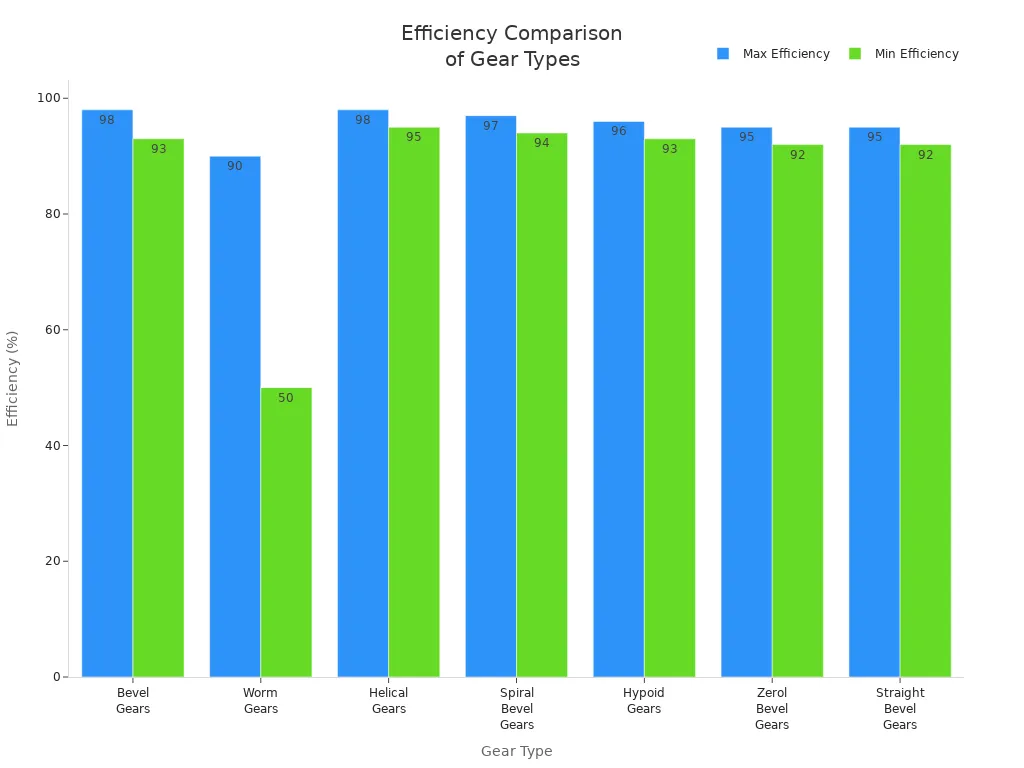
I notice that this high efficiency, along with the ability to handle various angles, makes bevel gears a smart choice in many systems.
Key Takeaways
●Bevel gears transmit power between shafts at various angles, making them versatile for different mechanical designs.
●These gears offer high efficiency, typically between 93% and 98%, ensuring reliable performance in various applications.
●Choosing bevel gears allows for adjustments in speed and torque, making them ideal for complex systems like automotive differentials and industrial machinery.
Bevel Gear vs. Miter Gear Differences
Bevel Gear Structure and Function
When I look at a bevel gear, I see a cone-shaped gear that lets me transmit power between shafts that meet at almost any angle. The teeth on a bevel gear can be straight or spiral. Straight bevel gears have teeth that meet at the intersection of the shaft axes. Spiral bevel gears, like the Gleason type, have shifted teeth. This design spreads out the force and gives the gear more strength. I can choose the number of teeth and the pitch circle diameter based on my needs. This flexibility helps me match the gear to the specific requirements of my mechanical system.
Here is a quick comparison of some structural features:
| Feature | Bevel Gears | Miter Gears |
|---|---|---|
| Number of Teeth | Can vary as needed | Must be equal |
| Shaft Angle | Flexible design, can be almost any angle | Can only be arranged vertically |
| Pitch Circle Diameter | Generally not equal | Equal |
| Pitch Cone Angle | Angles differ between gears | Usually equal at 45° |
I often use bevel gears when I need to change the direction of power flow or adjust the speed and torque in a system.
Miter Gear Structure and Function
Miter gears are a special type of bevel gear. I use them when I want to transmit power between two shafts at a 90-degree angle, but I do not want to change the speed. Miter gears always have the same number of teeth on each gear, which means they have a 1:1 gear ratio. The pitch circle diameters are equal, and the pitch cone angles are usually 45°. I find miter gears in applications where I need simple, efficient direction changes without altering speed or torque.
Some common materials for both bevel and miter gears include 303 stainless steel and 2024-T4 aluminum anodized. These materials give the gears strength and durability for different environments.
Key Distinctions and Applications
The main difference I notice between a bevel gear and a miter gear is flexibility. Bevel gears can operate at a wide range of angles, from 1° to 180°, and I can select different gear ratios to increase or decrease speed and torque. Miter gears, on the other hand, only work at a 90° angle and always have a 1:1 ratio.
Here is a table that highlights these differences:
| Feature | Bevel Gears | Miter Gears |
|---|---|---|
| Operational Angle | 1° to 180° | Exclusively 90° |
| Gear Ratio | Flexible, can be designed as needed | Fixed at 1:1 |
| Applications | Automotive, heavy machinery, aerospace, industrial gear drives | Robotics, conveyor systems, printing presses, machine tools |
I use bevel gears in automotive differentials, heavy machinery, and industrial plant equipment because I need to change speed, direction, or torque. For example, in a car differential, the bevel gear lets the wheels turn at different speeds while still receiving power. In contrast, I use miter gears in simpler systems like robotics or conveyor belts, where I only need to change the direction of rotation without affecting speed.
The mechanical advantage of bevel gears varies based on the number of teeth between the driver and driven gears. This lets me fine-tune the performance of my system.
When I need to adjust speed or torque, I always choose a bevel gear. If I only need to change direction at a right angle, I pick a miter gear. This choice helps me design efficient and reliable mechanical systems.
Bevel Gear Benefits and Uses
Changing Shaft Angles
When I design a mechanical system, I often need to transmit power between shafts that do not meet at a right angle. A bevel gear gives me the flexibility to set the shafts at almost any angle I want. This feature stands out because most other gears, like miter gears, only work at 90 degrees. I can use bevel gears to connect shafts at 30, 45, 60, or even 120 degrees. This flexibility helps me fit the gear system into tight spaces or unusual layouts. I do not have to redesign the whole machine just to match a fixed angle. The ability to transmit power at different angles makes bevel gears a smart choice for many engineers.
Power Transmission Flexibility
I always look for gears that can handle different speeds and loads without losing efficiency. Bevel gears perform well in this area. They can change both the direction and the speed of rotation. This means I can adjust the torque and speed to match the needs of my system. I also notice that bevel gears have high efficiency compared to other gear types. For example, straight, spiral, and zerol bevel gears reach efficiency levels between 97% and 99.5%. Hypoid bevel gears also perform well, with efficiency up to 98%. Here is a table that compares the efficiency of different gear types:
| Type of Gear | Approximate Range of Efficiency |
|---|---|
| Straight Bevel Gear | 97 – 99.5% |
| Spiral Bevel Gear | 97 – 99.5% |
| Zerol Bevel Gear | 97 – 99.5% |
| Hypoid Bevel Gear | 90 – 98% |
| Worm Drive | 40 – 90% |
Several factors affect the efficiency of a bevel gear. These include tooth geometry, surface finish, lubrication quality, alignment, and the speed and load of the system. I always pay attention to these details to get the best performance from my gears.
Bevel gears also adapt well to different mechanical systems. They can handle high torque and heavy loads. I use them in places where I need smooth operation and reliable power transfer. In my experience, bevel gears outperform worm gears in efficiency, especially in systems that require high load capacity.
Common Mechanical Applications
I see bevel gears used in many industries because of their versatility. Here are some practical examples:
●Automotive Differentials: I use bevel gears in car differentials to split torque between the wheels. This setup allows each wheel to turn at a different speed during a turn. The bevel gears ensure smooth power transfer, reduce noise, and improve traction and handling.
●Industrial Machinery: I rely on bevel gears in machine tools, mining equipment, and conveyor systems. They let me change both the direction and speed of rotation, which is not possible with miter gears. This flexibility helps me design machines that fit specific tasks and spaces.
●Aerospace and Heavy Equipment: I choose bevel gears for aerospace and heavy machinery because they handle high loads and provide reliable performance. Their ability to work at various angles and gear ratios makes them ideal for complex systems.
Tip: When I need to adjust speed, torque, or direction in a mechanical system, I always consider using a bevel gear. Its adaptability and efficiency make it a top choice for many applications.
I choose bevel gears for their flexibility, high efficiency, and ability to fit many shaft angles. These gears support compact layouts, smooth operation, and high torque. When I design a system, I always compare bevel and miter gears to match my exact needs.
FAQ
What is the main reason I pick bevel gears over miter gears?
I choose bevel gears when I need to change speed or torque, not just direction. Miter gears only let me change direction at a right angle.
Can bevel gears handle high loads?
I use bevel gears in heavy machinery because they handle high loads well. Their design spreads force across the teeth, which increases strength.
Do bevel gears need special maintenance?
●I check lubrication often.
●I inspect for wear or misalignment.
●I replace damaged gears quickly to keep my system running smoothly.
Post time: Jun-17-2026