


bevel gear

I often see how a bevel gear changes the direction of power between two shafts that meet, usually at a right angle. Its special tooth design lets machines run smoothly and save energy, even in tight spaces. 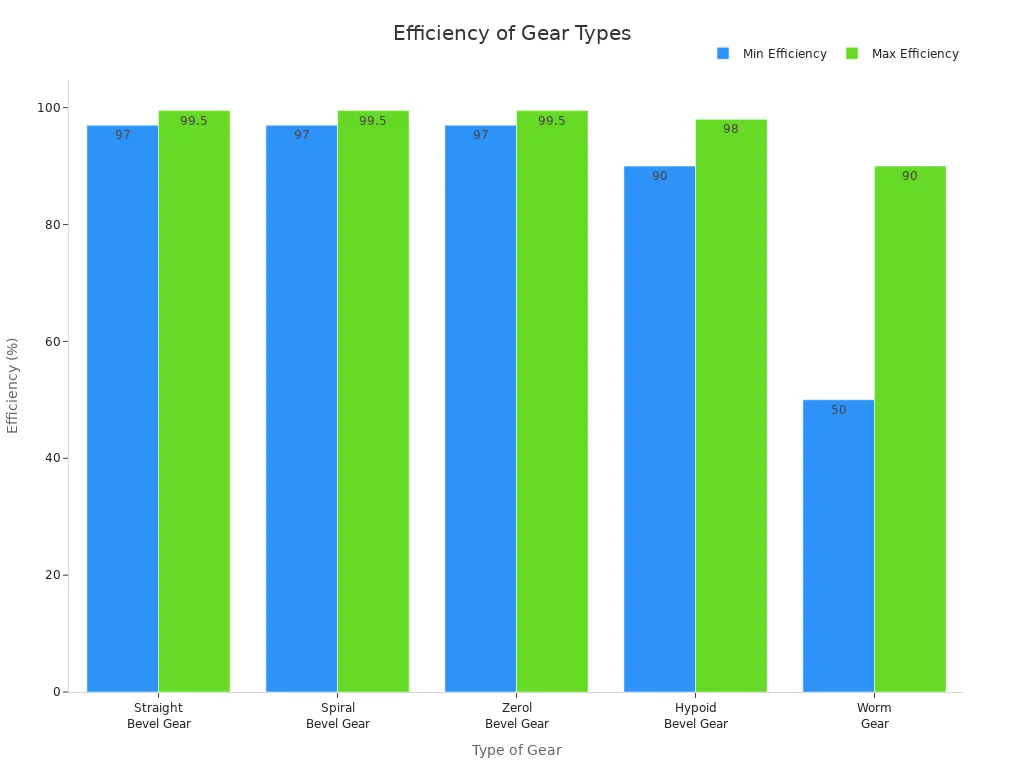
Key Takeaways
●Bevel gears change the direction of power between intersecting shafts, usually at a right angle, making them essential in various machines.
●Choosing the right bevel gear type—straight, spiral, or hypoid—depends on the application, with spiral gears being ideal for high-speed and high-load situations.
●Regular maintenance, including lubrication and inspections, is crucial for extending the life of bevel gears and ensuring smooth operation.
bevel gear basics
definition and structure
I see a bevel gear as a unique mechanical component. Its teeth are cut along the surface of a cone, not a cylinder like other gears. This conical shape lets the gear transfer power between shafts that meet at an angle. When two bevel gears mesh, their cone apexes coincide, and their axes intersect at that point. This design allows the gears to change the direction of rotation efficiently.
Note: The conical geometry of bevel gears helps reduce vibrations and noise. It also supports high load-bearing capacity, making them suitable for heavy-duty machines.
Here is a table that shows how the structure affects performance:
| Characteristic | Explanation |
|---|---|
| Conical Shape | Enables power transmission between intersecting shafts at specific angles. |
| Geometry of Conical Surfaces | Ensures smooth engagement of gear teeth and reduces vibrations. |
| Torque Transmission | Handles torque with minimal energy loss and high efficiency. |
| Load-Bearing Capacity | Designed for heavy loads in demanding applications. |
| Noise and Vibration Reduction | Provides quieter and smoother operation. |
bevel gear vs other gears
I often compare bevel gears to spur gears and worm gears. Spur gears have parallel shafts, so power flows in a straight line. Bevel gears, on the other hand, connect shafts that meet at an angle. This difference changes how machines transmit torque.
- Bevel gears transmit power between intersecting axes.
- Spur gears transmit power between parallel axes.
- Worm gears offer high ratios but lower efficiency compared to bevel gears.
Here is a quick comparison:
| Gear Type | Shaft Orientation | Power Transmission Direction | Layout Complexity | Bearing Load Predictability |
|---|---|---|---|---|
| Spur Gears | Shafts remain parallel | Power flows in a straight line | Simpler | More predictable |
| Bevel Gears | Shafts meet at an angle | Torque direction changes | More complex | Less predictable |
I notice that bevel gears provide higher efficiency, usually between 94-98%, while worm gears operate at 50-85%. This efficiency makes bevel gears a better choice for applications where energy savings matter.
bevel gear operation and applications
Post time: Jun-11-2026