


An accurate spiral bevel gear quote starts with a complete RFQ. Suppliers price what you define, so give them these inputs up front:
| RFQ Input | What It Covers |
|---|---|
| Drawing and gear data | Controlled 2D drawing, gear data block |
| Material and heat treatment | Steel grade, case depth, hardness |
| Accuracy and inspection | Standard, grade, backlash, reports |
| Quantity and lot size | Prototype or production volumes |
| Mating information | Matched pinion and gear data |
| Application conditions | Load, speed, duty cycle, environment |
These parts are generated on specialized machines. Missing data forces suppliers to pad prices or quote on assumptions. Each category below covers, in turn, the specific data points you should include.
Key Takeaways
●Send a controlled 2D drawing with a gear data block to define tooth geometry and tolerances.
●Specify the exact steel grade and heat treatment requirements to avoid supplier assumptions.
●State the accuracy standard, grade, backlash, and contact pattern to ensure proper inspection.
●Provide both immediate order quantity and annual forecast to get accurate pricing.
●Include application conditions and mating gear data for a complete and reliable quote.
Spiral Bevel Gear Drawings and Gear Data
Controlled Drawing Essentials
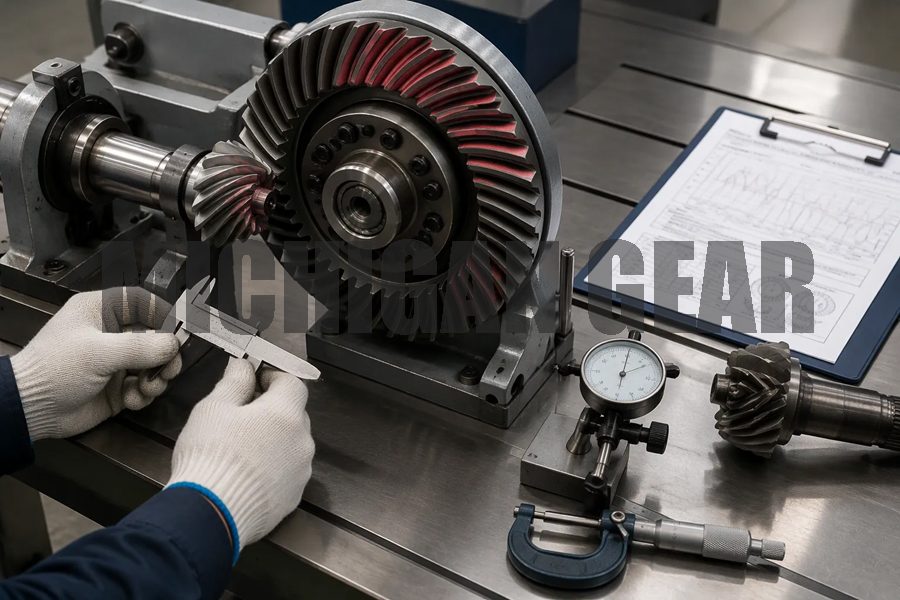
A controlled 2D drawing is the baseline for an accurate quote. It carries the tolerances, the accuracy class, and the inspection criteria that define the part. Without it, a supplier cannot tell which features matter and which features allow normal machining variation. The supplier must then guess, and guesses turn into padded prices or assumptions that surface later as disputes.
A controlled drawing means a released revision with a revision block, a title block, and clear dimensioning. Every critical feature needs a tolerance. The accuracy class belongs on the drawing, not in a separate email. When the drawing states the accuracy grade and the tolerances together, the supplier can plan the machining sequence and the inspection steps around them. That planning is what makes a firm price possible.
Send the drawing as a PDF or a native CAD file with the revision clearly marked. Confirm that the revision you send matches the revision your engineering team has released. A mismatched revision is one of the most common causes of a quote that later changes.
Gear Data Block Fields
The gear data block sits on the drawing and defines the tooth geometry. Include these fields:
●Gear type, such as straight bevel, spiral bevel, or Zerol
●Number of teeth
●Module or diametral pitch
●Pressure angle
●Hand of spiral
●Mounting and datum features used for inspection
Each field removes a decision from the supplier’s hands. The hand of spiral, for example, determines the direction of the cutting stroke and the setup on the generating machine. The datum features tell the inspector where to locate the part, so the measured values match the drawing values.
State the mounting distance and the shaft angle when the gear mounts against a mating part. These values control the contact pattern position. A drawing without them leaves the supplier to assume a standard arrangement, and the assumption may not match your assembly.
A 3D model supports the drawing. It helps the supplier visualize the part and check for interference. The model does not replace the controlled 2D drawing, however. Tolerances, datums, and the gear data block live on the drawing. Treat the model as a supplement and the drawing as the controlling document. This distinction keeps the quote accurate and keeps the delivered part consistent with what you specified.
Material and Heat Treatment
Gear Steel Specification
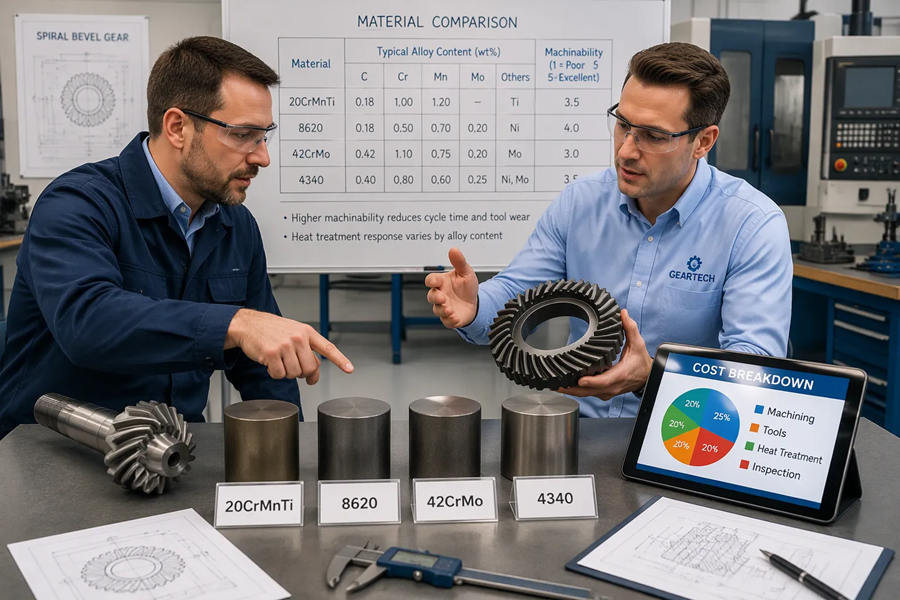
The steel grade you specify drives both cost and lead time. Common gear steels differ in alloy content and hardenability. A through-hardening grade costs less than a case-hardening grade, yet it carries lower surface durability. Tell the supplier the exact grade and the material condition you want. Forged blanks cost more than bar stock, and they add forging lead time to the schedule. Bar stock suits smaller gears and short runs. Forgings suit larger gears and production volumes, where grain flow follows the tooth form.
State the condition on the RFQ: as-forged, normalized, annealed, or pre-hardened. Each condition adds a processing step and a delivery interval. A normalized blank machines more predictably than a raw forging. That predictability shows up in a firmer price. Include the material specification and the certification you need with delivery. A mill certificate adds traceability, and the supplier will price that documentation into the quote.
Case Depth and Surface Hardness
Heat treatment requirements belong on the drawing, not in a side note. Case-hardened gears need a specified case depth and a surface hardness range. Give both as values with tolerances. The case depth controls the load capacity of the tooth flank and the core strength beneath it. A deeper case takes longer in the furnace, and furnace time is a direct cost driver. The surface hardness range tells the supplier which process to plan, such as carburizing or nitriding.
Specify the hardness method and the test location. State whether you need hardness checked at the tooth flank, the root, or the core. Name the inspection document you expect, such as a heat-treat certificate with hardness results. When you leave case depth and hardness open, the supplier picks a default. That default may not match your duty cycle, and the mismatch appears only after the parts run. Put the values on the drawing and repeat them in the RFQ so nothing gets lost.
Accuracy, Tolerances, and Inspection
Accuracy Standard and Grade
Name the accuracy standard and its revision on the RFQ. Gear accuracy systems differ in how they define tooth-to-tooth error, total composite error, and runout. A supplier who receives only a grade number without the standard behind it cannot plan the inspection. State the standard by name and revision, then state the grade you require. The grade sets the tolerance band for each measured element, and that band determines how much time the part spends on the inspection bench.
For a matched spiral bevel gear set, tell the supplier how you want the pair selected. Matched sets are lapped together, so the pinion and the gear are tested as a unit. State whether you need the pair matched by contact pattern, by backlash, or by both. State whether the parts must ship as a numbered pair or as interchangeable components. A numbered pair costs more because the supplier cannot swap parts between sets. Interchangeable parts need tighter individual tolerances to work with any mate.
Backlash, Contact Pattern, and Reports
Backlash and contact pattern define how the pair behaves in your assembly. Give the backlash as a range at a stated mounting distance. The mounting distance matters because backlash changes as the gears move along their axes. A backlash value without a reference point means little to the inspector.
Contact pattern requirements belong on the drawing as well. Describe where the pattern should sit on the tooth, how large it should be, and which load condition you use for the check. Many buyers specify the pattern at light load and confirm it at a higher load. Tell the supplier which method you accept, such as marking compound on a rolling test.
List the inspection reports you expect with delivery. Common documents include:
| Document | What It Confirms |
|---|---|
| Dimensional report | Drawing dimensions and tolerances |
| Gear accuracy chart | Tooth element deviations against the stated grade |
| Contact pattern record | Pattern location and size on the tested pair |
| Material and heat-treat certificates | Steel grade, case depth, hardness |
Ask for a first-article inspection report on new parts. The first article confirms the process before production runs. For production orders, agree on the sampling plan and the frequency of reports. Put the documentation list in the RFQ so the supplier prices the inspection work into the quote. Inspection time is real cost, and a supplier who knows the report list up front gives you a firmer number.
Quantities, Lot Size, and Delivery
Prototype and Production Volumes
Tell the supplier which stage your project is in. A prototype order of a few pieces, a short run, and a production volume each carry a different cost structure. Setup time on the generating machine spreads across the lot. A small lot absorbs the same setup cost over fewer parts, so the unit price climbs. A large lot spreads that setup across many pieces, and the unit price falls.
State the annual volume as well as the immediate order quantity. Suppliers plan tooling and machine time around the expected total. A buyer who orders ten pieces now and hints at thousands later gets a different price than one who orders ten pieces with no forecast. Give both numbers plainly.
Lead Time and Repeat Orders
Ask for lead time in two parts: the time to first article and the time to full delivery. The first article confirms the process before the run continues. Heat treatment and inspection add their own intervals, so a realistic schedule accounts for each step. State your required delivery date and ask the supplier to confirm it against their capacity.
For repeat orders, say whether the design will stay fixed. A stable design lets the supplier keep the setup and the process plan, and repeat pricing usually improves. A design that changes between orders resets that work.
Use this checklist to assemble the RFQ:
| Item | Include |
|---|---|
| Drawing | Controlled 2D drawing with revision |
| Gear data | Type, teeth, module, pressure angle, hand of spiral |
| Material | Steel grade and condition |
| Heat treatment | Case depth and hardness range |
| Accuracy | Standard, revision, grade, backlash, contact pattern |
| Quantity | Order quantity and annual forecast |
| Mating data | Pinion and gear pair details |
| Application | Load, speed, duty cycle, environment |
Common scenarios need a clear response. If your data is incomplete, send what you have and mark the gaps. If you want a quote from a sample, send the sample plus any known specifications. Flag missing items in a short list at the end of the RFQ. Ask the supplier which missing items affect price most. That question turns a rough estimate into a firm number for your spiral bevel gear order.
Spiral Bevel Gear Application and Documentation
Operating Conditions
Your application data tells the supplier how hard the gear will work. State the load the gear carries, both steady and peak. Give the speed in rpm at the input and the output. Describe the duty cycle: how long the gear runs, how often it starts and stops, and whether shock loads occur. A gear that runs continuously under steady load needs a different design than one that sees frequent reversals. The supplier uses these facts to size the tooth form and pick the heat treatment.
Environment shapes material and protection choices. Note the temperature range, the presence of dust, moisture, or corrosive agents, and whether the gear runs lubricated or dry. A hot, dirty environment may call for a different steel grade or a surface treatment. Each added requirement carries a cost, so state the real conditions rather than a worst case. Honest application data keeps the price fair and the part reliable. Include this information for every spiral bevel gear inquiry, even a repeat order, because conditions sometimes change.
Mating Gear and Pinion Data
Matched sets need both halves defined. When you order a pinion and gear as a pair, send the data for both parts: tooth counts, hands of spiral, mounting distances, and shaft angle. The supplier laps the pair together and tests the contact pattern as a unit. A quote for one half of a set rests on assumptions about the other half, and those assumptions rarely hold.
Attach the standards and quality documents your project requires. Name any governing accuracy standard by revision. Include your quality plan, first-article requirements, and any customer-specific documentation. A short note on the assembly the gears fit into helps the supplier understand the mounting. Flag any missing mating data openly and ask which items affect price most. That question turns a partial RFQ into a firm quote.
Quote accuracy follows RFQ completeness. Each category you define — drawings, material, accuracy, quantity, mating data, application — removes one pricing assumption from the supplier’s desk. A complete spiral bevel gear RFQ leaves little room for padding or guesswork.
Build a reusable checklist or template from the tables above. Run every future inquiry through it, and no data point slips through on a busy day.
Flag incomplete data openly. Ask the supplier which missing items affect price most. That question beats accepting a rough estimate from a partial RFQ.
FAQ
Can you quote a spiral bevel gear if I only have a sample?
Yes, in many cases. Send the sample plus any known specifications, such as tooth counts and mounting distances. Mark the sample clearly as the reference part. Ask the supplier which measurements they will take from it. Expect the quote to carry some assumption until the supplier confirms the geometry against a drawing.
Is a 3D model enough to get a firm price?
No. A 3D model helps the supplier see the part, but it carries no tolerances, datums, or gear data block. Those live on the controlled 2D drawing. Send both files, and treat the drawing as the controlling document. A model alone leaves the supplier guessing at accuracy and inspection criteria.
How much does lot size change the unit price?
Setup time on the generating machine spreads across the lot. A small lot absorbs the same setup cost over fewer parts, so the unit price climbs. A large lot spreads that setup across many pieces, and the unit price falls. State your annual forecast alongside the immediate order quantity.
What should I send when replacing an existing gear?
Send the original drawing if you have it. If not, provide the sample, the mating pinion data, and the mounting distance. Note the application conditions and any wear you observed. Flag which dimensions you can measure and which you cannot. The supplier will tell you which gaps affect price most.
What happens if I leave some RFQ fields blank?
The supplier must assume a value for every blank field. Those assumptions turn into padded prices or later disputes. Send what you have and list the gaps openly at the end of the RFQ. Ask which missing items matter most for pricing. That question turns a rough estimate into a firm number.
Post time: Nov-23-2026