


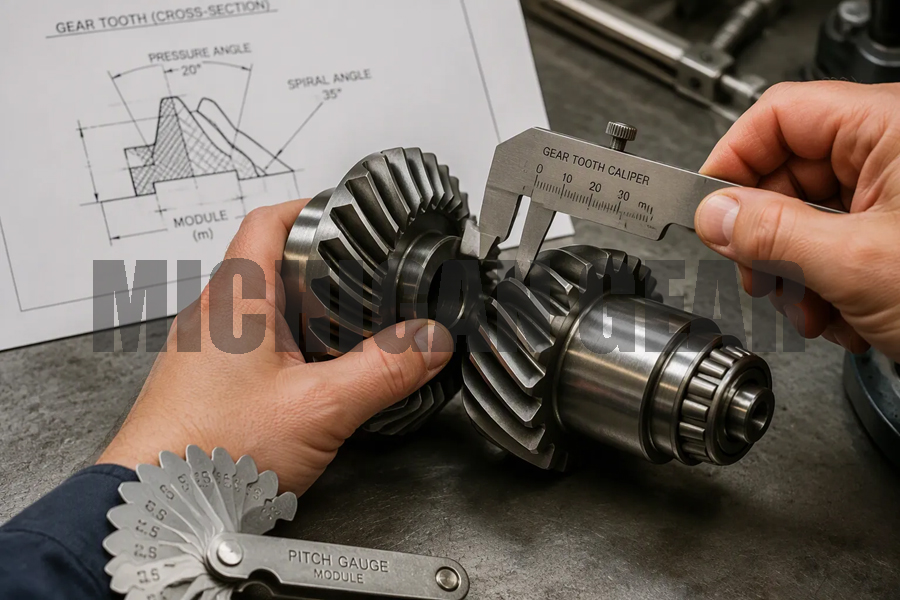
Choosing the right spiral bevel gear comes down to three things. You must understand your application requirements. You compare gear types. Finally, you weigh performance factors like noise, durability, efficiency, and cost.
These gears are not automatically the best choice for every setup. The right decision depends on your load, noise tolerance, and budget. This gear selection guide walks you from options to comparison to final decision.
You need to match speed and torque demands to the gear’s capabilities. A gear that works well in one machine may fail in another. The wrong choice can cause noise, wear, or early failure. The right choice delivers smooth power transfer and long service life.
Key Takeaways
- Spiral bevel gears run quieter and handle higher loads than straight bevel gears.
- A 35-degree spiral angle balances smooth operation and manageable axial thrust.
- Spiral bevel gears cost 20-50% more but can achieve 99% efficiency.
- Choose spiral bevel gears for high-speed, heavy-load applications with strict noise limits.
- Replace spiral bevel gears as matched sets to avoid wear and poor performance.
Bevel Gear Options and Spiral Bevel Gear Basics
Common Bevel Gear Types
You have four main options when you need to transfer power between intersecting shafts. Each gear type offers distinct trade-offs.
Straight bevel gears feature teeth cut straight toward the cone apex. They cost less and tolerate mounting variations well. However, point-contact meshing concentrates force at a single spot. This design produces higher vibration and noise, limiting them to low-speed applications.
Zerol bevel gears use curved teeth with a zero-degree spiral angle. They run smoother than straight bevels while generating minimal axial force. This makes them a practical middle ground for precision machinery needing moderate load capacity.
Hypoid bevel gears work with non-intersecting shafts. The offset design allows larger pinions and higher torque transmission. Automotive rear axles commonly use this configuration.
Spiral bevel gears have curved, oblique teeth that engage gradually. This gradual contact creates smoother operation and higher load capacity.
| Gear Type | Key Advantage | Main Limitation |
|---|---|---|
| Straight Bevel | Simple, low cost | Noisy, low load capacity |
| Zerol Bevel | Low axial force | Moderate load capacity |
| Hypoid Bevel | High torque capacity | Requires special lubricants |
| Spiral Bevel | Quiet, high load capacity | Needs matched pairs |
What Sets Spiral Bevel Gears Apart
The curved tooth geometry of a spiral bevel gear delivers measurable performance gains. The contact ratio for straight bevel gears typically ranges from 1.2 to 1.5. Spiral bevel gears achieve 1.8 to 2.5, with most designs reaching at least 2. This higher contact ratio means more teeth share the load at any moment.
The gradual engagement of curved teeth reduces vibration and acoustic noise significantly. This characteristic makes spiral bevel gears ideal for demanding applications. Rotorcraft drive systems rely on them to redirect power from horizontal engines to vertical rotors under high speed and heavy load.
These gears handle circumferential speeds well beyond the 2–3 m/s limit of straight bevels. You get higher load-carrying capacity and longer service life. The trade-off involves greater axial thrust, which requires robust bearings. You must also replace them as matched sets.
Straight vs. Spiral Bevel Gears
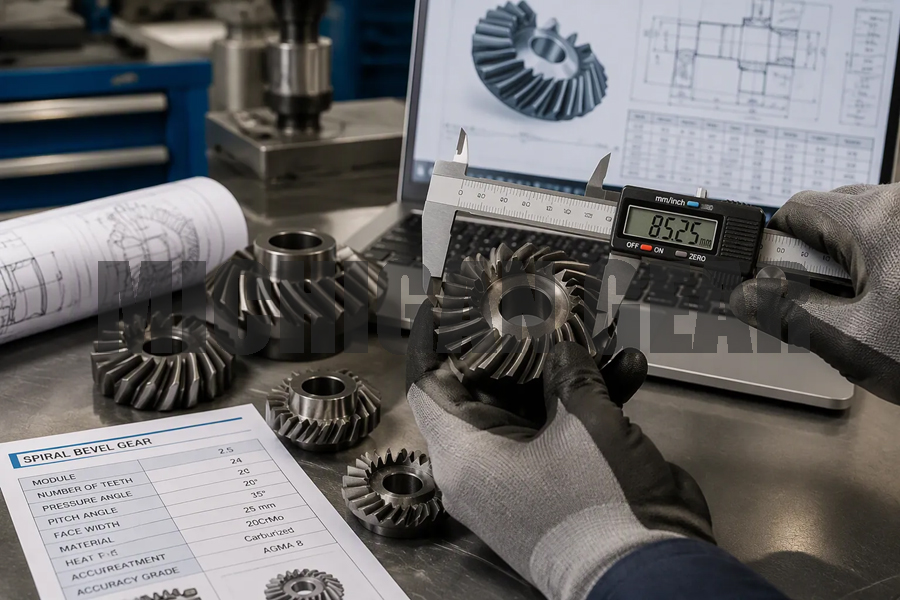
Noise, Durability, and Efficiency Differences
The shape of the teeth changes how the gears behave. Straight bevel gears make contact abruptly across the full face width. That sudden line contact creates impact forces, noise, and vibration. Spiral bevel teeth begin contact at one end of the curved tooth and engage progressively along the tooth length. This gradual engagement produces smoother, quieter operation. It also reduces impact forces and distributes load over a larger area and a longer duration.
The progressive point contact of spiral bevel gears avoids the instantaneous impact loading that straight bevel gears experience. You get better load-carrying behavior and less wear over time. A high-quality spiral bevel gear set can achieve 99% efficiency under the right conditions. That number reflects the smooth, rolling action of curved teeth under proper lubrication and alignment.
A 35-degree spiral angle offers a good balance of overall performance while keeping axial force controllable. This is why it is widely adopted in general applications. A large spiral angle of 35 to 40 degrees is typically chosen to reduce transmission vibration. The spiral angle enables progressive meshing, which increases contact line length and contact ratio. That reduces vibration and instability during meshing.
Zerol bevel gears are similar to spiral bevel gears, except they use a 0-degree helix angle rather than the 35-degree angle primarily used for spiral bevel gears.
Surface finish and contact pattern also matter for quiet running. For spiral bevel gears, spherical crowning is commonly used, with the contact pattern centered on the active tooth flank. Oversized reliefs reduce contact area, increase stresses, and raise noise. Undersized reliefs make the tooth contact overly sensitive. Improved surface finish through lapping and superfinishing can support quieter operation.
Axial Thrust, Cost, and a Quick Reference Table
The 35-degree spiral angle affects thrust loads in a way similar to the helix angle in helical gears. You must account for this axial force when you select bearings and design the housing. Straight bevel gears generate minimal axial thrust, which simplifies support structures.
Cost is another dividing line. For the same material, size, and tolerance, spiral bevel gears are reported to cost 1.2 to 1.5 times more than straight bevel gears. That implies a typical cost premium of about 20% to 50%. This difference can increase for small gear sizes or when high finishing requirements are applied.
| Factor | Straight Bevel Gears | Spiral Bevel Gears |
|---|---|---|
| Noise | Higher at medium or high speed | Quieter when correctly made and assembled |
| Durability | Higher wear rates from direct impact | Generally less wear and longer service life |
| Efficiency | Lower due to abrupt contact | Up to 99% under the right conditions |
| Axial Thrust | Minimal | Significant, requires robust bearings |
| Cost | Lower base cost | 1.2 to 1.5 times higher for equivalent size |
This gear efficiency comparison shows why the choice depends on your priorities. A quiet, durable drive justifies the higher cost. A low-speed, budget-driven unit may not need it.
Key Selection Factors: Spiral Angle, Pressure Angle, Pitch and Module
Spiral Angle and Pressure Angle
The spiral angle shapes how teeth engage and how much axial force the gear produces. The most common standard spiral angle on a spiral bevel gear is 35 degrees. Curved teeth at this angle provide smoother, quieter, and higher load-carrying action than straight cut teeth.
Axial thrust depends on the hand of the spiral (left or right) and the direction of rotation. The hand and rotation determine whether the thrust pulls the gears into tighter mesh or pushes them apart. Your housing and bearings must handle these shifting forces. A 35-degree spiral angle generates significant axial thrust, so you cannot ignore it during design.
The pressure angle also plays a central role in tooth strength. Standard pressure angle values include 14.5 degrees, 20 degrees, and 25 degrees. A 14.5-degree pressure angle produces a relatively thinner root. It becomes more susceptible to undercutting at low tooth counts. A 20-degree pressure angle offers a balanced, practical root strength and serves as a widely used modern standard. A 25-degree pressure angle gives a thicker root and reduces undercutting concerns at lower tooth counts.
The general trend is clear. As pressure angle increases, the tooth root becomes thicker and bending-stress resistance improves. Lower values trigger more undercutting under comparable conditions. Heel-side teeth show improved bending strength due to thicker roots and elevated angles. Tip narrowing at the toe may require you to increase the face cone angle or add a face cone chamfer. This reduces tooth height but lowers the profile contact ratio. Skipping these modifications increases the profile contact ratio, but bending strength declines from root undercutting. Uniform tooth depth avoids root undercutting and maintains profile contact ratio.
Pressure angle forms part of a more complex three-dimensional geometry. Consider it together with pitch geometry, spiral angle, and tooth-surface geometry.
| Gear type | Spiral angle | Contact-ratio effect | Axial-thrust effect |
|---|---|---|---|
| Straight-cut | 0° | Abrupt full-face tooth contact; lower contact ratio | Moderate thrust |
| Spiral-cut | Non-zero (>0°) | Curved teeth engage gradually, increasing contact ratio and load sharing | High thrust; direction depends on the spiral hand and rotation |
| Zerol-type | 0° | Curved teeth give gradual engagement like spiral gears | Moderate thrust, similar to straight types |
Pitch, Module, and Other Specs
Pitch and module define the size and spacing of the teeth. The pitch and module must match between the gears in a set. Consider the shaft speed or torque your application demands. The gear must carry that load without overloading the tooth faces.
You should verify the pitch angle, face width, and tooth depth against the load. A higher module means larger teeth and greater load capacity. It also adds space and weight. The right angle between shafts is the most common configuration for spiral bevel sets. Confirm the exact shaft orientation before you select a catalog part.
Tooth geometry, lubrication, and assembly quality all matter. A well-designed set can reach 99 percent efficiency under the right conditions. That performance level makes spiral sets attractive for applications where energy loss matters. You should also review backlash and contact pattern for your planned speed range. These factors affect noise and service life as much as the basic tooth specifications.
Applications, Benefits, and Custom Design Decisions
Where Spiral Bevel Gears Are Used and Why They Pay Off
You find spiral bevel gears in demanding applications that combine high speeds, heavy loads, and strict noise limits. Rotorcraft transmissions, automotive axles, and industrial drive systems all rely on them. Research on the OH-58D helicopter main-rotor transmission recorded roughly a 16 dB noise decrease at full torque compared to a baseline design. That improvement came with lower pinion tooth stresses and better cabin comfort.
These gears pay off through lower weight, less space, and lower overall cost. High torque capacity in heavy-duty applications reduces equipment size and weight compared to alternative drive configurations. A high-quality set can reach 99% efficiency under the right conditions. That performance level matters when energy loss drives your operating budget.
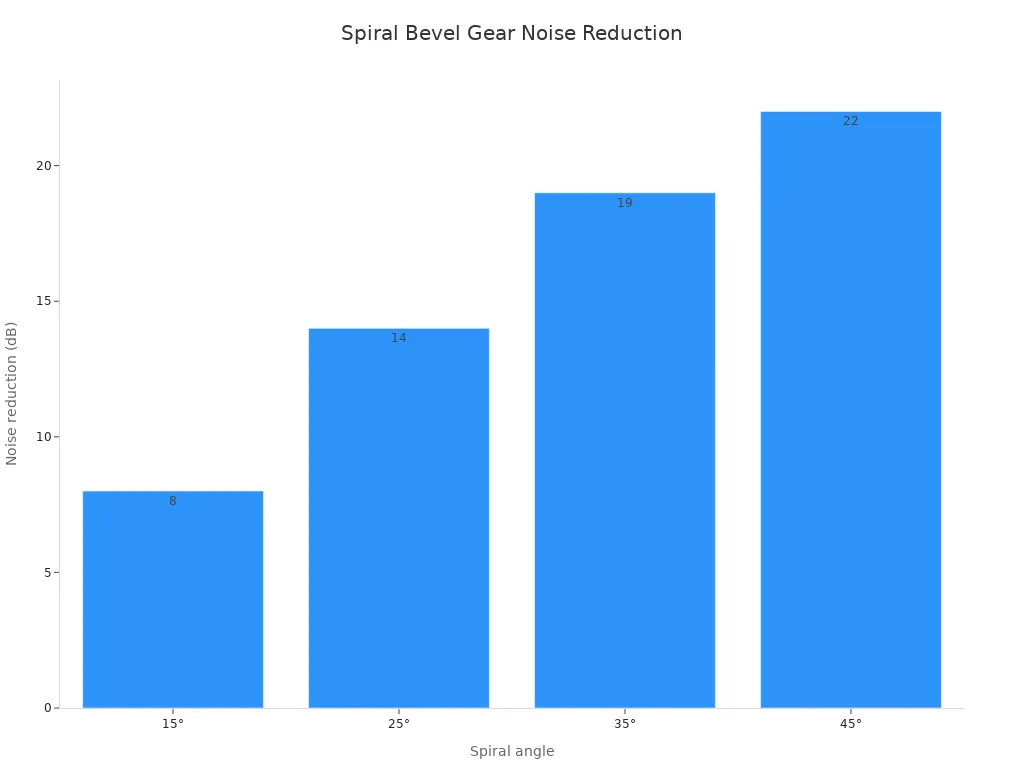
The table below shows how spiral angle affects noise, efficiency, and axial force.
| Spiral angle | Face contact ratio | Noise reduction vs. 0° | Transmission efficiency | Axial force increase |
|---|---|---|---|---|
| 15° | 1.10 | ~8 dB | 98.5% | +12% |
| 25° | 1.28 | ~14 dB | 98.0% | +22% |
| 35° (most common) | 1.52 | ~19 dB | 97.5% | +38% |
| 45° | 1.71 | ~22 dB | 96.8% | +58% |
Lightweight steel alloys with niobium microalloying now enter production for electric drive differential systems. They deliver 10–15% weight reduction with equivalent fatigue performance. That gain comes from the alloy, not the gear geometry.
When a Custom Spiral Bevel Gear Is Needed
Shaft arrangement is your primary selection criterion. A bevel gear transfers power between intersecting shafts, commonly at a 90° angle, though builders can produce other pitch angles. A right angle gearbox is a shaft configuration, and spiral bevel designs suit it well. Standard gearboxes in 1:1 and 2:1 ratios cover most needs. Ratios outside that range may require a custom configuration.
Backlash and precision also guide your choice. Under half a degree of backlash keeps torque transfer efficient. Low-backlash designs serve high-precision positioning work. Consider replacement risk too. Spiral bevel gears need less maintenance because reduced wear lets basic lubrication keep them running. They cost more, so choose them when higher performance is justified.
A custom spiral bevel gear makes sense when your shaft orientation, gear ratio, or backlash target falls outside catalog options. High-performance sets demand precise installation, shaft alignment, and sound bearing arrangement. Match the gear type to your operating conditions before you commit.
Match the gear to your load and speed first. Choose straight bevel gears for simple, low-to-medium speed drives. Choose spiral bevel gears when you need smooth, high-load operation without shaft offset. Prioritize noise and durability where they matter most, and weigh cost against customization needs. Remember that efficiency and quiet running justify a higher price only when your application demands them.
The right spiral bevel gear is the one that fits your application, not simply the most advanced or most expensive option. Make your selection of gears with confidence. Contact a qualified bevel gear manufacturer or request a quote based on your specific parameters.
FAQ
What spiral angle should you choose for a spiral bevel gear?
A 35-degree spiral angle is the most common standard. It balances smooth operation with manageable axial thrust. Larger angles reduce vibration further but increase axial force. Smaller angles lower thrust but produce more noise. Match the angle to your speed and load demands.
How does pressure angle affect gear strength?
A higher pressure angle creates a thicker tooth root. This improves bending-stress resistance. A 20-degree pressure angle serves as a widely used modern standard. A 25-degree pressure angle reduces undercutting concerns at low tooth counts. A 14.5-degree pressure angle produces a thinner root and risks undercutting.
When should you choose spiral bevel gears over straight bevel gears?
Choose spiral bevel gears when you need quiet operation at higher speeds. They handle heavy loads better and last longer. Straight bevel gears suit low-speed, budget-driven units. Spiral sets cost more but deliver up to 99% efficiency under the right conditions.
What factors affect the performance of a right angle gearbox?
Shaft arrangement, backlash, and bearing support all matter. A right angle configuration suits spiral bevel designs well. Keep backlash under half a degree for efficient torque transfer. Proper alignment and lubrication protect your transmission and extend service life.
Can you replace spiral bevel gears individually?
No. Spiral bevel gears work as matched sets. You must replace both gears together. Mixing parts from different sets causes poor contact patterns and premature wear. Always order a complete set when you need a replacement.
Post time: Oct-13-2026