


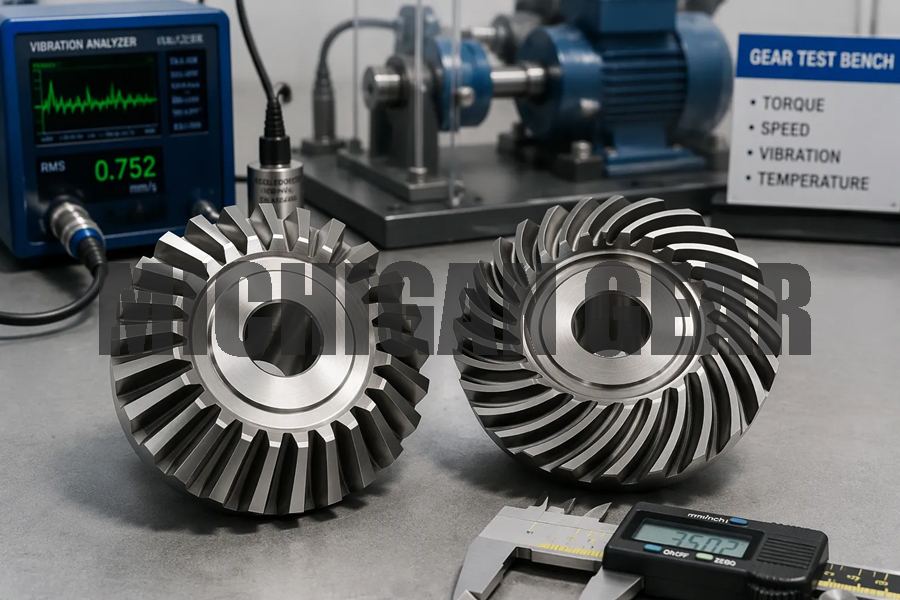
Neither gear type is always the best choice. Your machine’s speed, load, noise limits, and budget decide which one fits better. A high-speed drive with strict noise limits points one way. A low-speed, cost-sensitive unit often points the other.
Does your design need quiet running at speed, or simple, low-cost power transfer? That one question is at the heart of most spiral bevel gear and straight bevel gear decisions. Performance, cost, and maintenance all change with your answer. A practical decision guide will help you match the gear to your real operating conditions.
Key Takeaways
●Choose spiral bevel gears for high-speed, heavy-load machines that need quiet running.
●Choose straight bevel gears for low-speed, light-load machines where cost matters most.
●Spiral bevel gears carry 30–50% more torque and last longer in demanding use.
●Straight bevel gears cost less and are easier to replace one at a time.
●Always match the gear to your machine’s speed, load, noise limits, and budget.
What Is a Spiral Bevel Gear?
A spiral bevel gear is a bevel gear whose teeth are cut along spiral lines. Wikipedia says these teeth are angled like helical gear teeth, but they are curved too. The teeth follow a spiral path around the cone instead of a straight line. This curved, spiral shape is the main thing you can see that makes it different from straight bevel gears.
Curved Teeth and Gradual Meshing
The curved tooth shape changes how the gears meet. When two of these gears mesh, contact begins at one end of the tooth and spreads across the whole tooth, according to ZHY Gear. Two or more teeth share the load at the same time. Each tooth eases into the mesh instead of hitting all at once. This gradual contact makes the gears run smoother and quieter, and it cuts down on wear.
The igus toolbox explains that this tooth design lowers noise and vibration compared to straight-cut gears. It also lets the gear carry higher loads. Spiral bevel teeth can be polished too. Polishing lowers noise and vibration even more. This matters in precision work. The result is a drive that runs with less vibration across many speeds.
Best-Fit Applications
You will find this gear type in drives that need quiet running and high load capacity. Wikipedia lists the vehicle differential as a main use, where the drive direction must turn 90 degrees to drive the wheels. The helical design makes less vibration and noise than straight-cut gears.
Chamolgear describes several other good fits. Car differentials use the progressive meshing to spread load evenly across the tooth surface. Helicopter rotor drive systems depend on the 90-degree transmission and large contact area. Crusher drives in mining handle sudden impact loads that can reach 2–3 times the rated load. Robot joints gain from smooth meshing without sudden impact. IQS Directory adds automotive rear axles, industrial drives, and precision robotics to the list. These are all high-speed, heavy-duty uses. You should also think about this gear for any drive where noise limits are strict and loads are heavy.
What Is a Straight Bevel Gear?
A straight bevel gear is the most basic kind of bevel gear. Its teeth go straight, and if you extended them inward, they would meet where the shaft axles cross, as Belongear describes. The teeth spread out from that point along a tapered cone. This shape is easy to picture and easy to machine.
Straight Teeth and Simultaneous Contact
Straight teeth enter the mesh all at once. ZHY Gear explains the mechanics: you can think of the gear as several spur gears working side by side. As the driving wheel turns, the tooth pair with the smallest angle gap touches first. It bends under load, and the next pair joins only when the load needs it. The pairs engage in order until their combined capacity matches the outside torque.
This behavior has real effects. ZHY Gear notes that assembly errors in straight bevel gears cause severe off-load conditions during transmission. Those conditions increase meshing deformation and transmission errors. The result is lower load-bearing capacity and a shorter service life. ZHY Gear advises improving installation accuracy as much as possible to protect service life.
The manufacturing story is simpler. Wenlio calls the geometry simple, so these gears are cost-effective and easy to make. One trade-off: straight bevel teeth cannot be polished. That limits how much you can reduce noise and vibration, and Wenlio notes that noise and vibration rise at higher speed.
Best-Fit Applications
Straight bevel gears suit drives where simplicity and cost matter more than quiet running. Wenlio lists hand tools, low-speed conveyors, and light machinery as good fits. These applications run at modest speeds and tolerate more noise. They also reward a lower purchase price and straightforward sourcing.
Think about your own machine. Does it run slowly, carry light loads, and sit where some gear noise is acceptable? A straight bevel gear may serve you well. Does it run fast or demand quiet operation? Then the curved-tooth alternative deserves a closer look. Either way, check your installation accuracy, because ZHY Gear ties that directly to how long the gear pair lasts.
Structural Design Differences
Tooth Profile and Meshing Behavior
The tooth profile is the most basic thing that makes these two gear types different. Chamolgear explains that straight bevel gear teeth run straight along the cone. Spiral bevel gear teeth are helical and have a special parameter called the spiral angle. That one design choice changes how the teeth meet under load.
| Attribute | Straight Bevel Gear | Spiral Bevel Gear |
|---|---|---|
| Tooth shape | Straight tooth line | Curved tooth line |
| Meshing style | More direct tooth contact | More gradual tooth contact |
The way the teeth mesh comes from the profile. Chamolgear notes that straight bevel teeth touch at a point, so pressure tends to build up in a small area. Spiral bevel teeth touch along a continuous line, and several pairs share the load at once. Gearmfc describes the result: straight teeth engage somewhat abruptly, while spiral teeth enter and leave mesh little by little. You get a smoother transfer of load between one tooth pair and the next. Chamolgear adds that the previous pair has not fully separated before the next pair starts to mesh. This overlapping action is the main reason spiral bevel gears run with low noise and low vibration.
Axial Force and Interchangeability
Axial thrust deserves your attention when you pick bearings. All bevel gears make axial force, but Chamolgear points out that the helix angle in spiral bevel gears creates more significant axial thrust on the bearings. PTSmake confirms this: spiral bevel gears carry a high thrust load, while straight bevel gears carry a moderate one. You will need extra support structures in your design when you choose the spiral type.
Interchangeability is very different between the two. Chamolgear explains that spiral bevel gears have complex tooth surfaces, so each meshing pair is made as a matched set. You cannot replace one gear of the pair by itself without affecting how the pair meshes. Straight bevel gears give you more flexibility. You can replace them one at a time as long as key parameters such as the module and pressure angle match.
Spiral Bevel Gear Performance Advantages
Noise, Efficiency, and Load Capacity
The curved tooth of a spiral bevel gear changes how load moves through the mesh. With the same pitch, module, and material, a spiral bevel gear carries about 30–50% more torque than a straight bevel gear before it fails. That extra margin comes from gradual contact. Two or more teeth share the load at once, so each tooth eases into the mesh instead of striking it.
Chamolgear reports that the helical tooth trace removes impact during meshing. The result is smoother operation and lower noise. Straight bevel gears show poor meshing stability, with noticeable noise and vibration. Australia Drive puts the same contrast in a simple table:
| Characteristic | Straight Bevel Gear | Spiral Bevel Gear |
|---|---|---|
| Noise Level | High | Low |
| Vibration | Intense | Smooth |
| Efficiency | Relatively Low | Relatively High |
| Applicable Scenario | Low-speed, light-load applications | High-speed, heavy-load applications |
| Durability & Lifespan | Shorter | Longer |
Efficiency deserves a careful word. Wenlio warns against treating the spiral type as an automatic winner:
Q3: Are spiral bevel gears always more efficient than straight bevel gears?
Not always. Spiral bevel gears run smoother, but they can introduce extra sliding. The real result depends on speed, load, oil, and contact setup.
So the gain is real, but it depends on your setup. Spiral bevel gears also handle heavy shock loads well. Australia Drive describes a car maker that started with straight bevel gears in a differential. At high speed, the unit made a lot of noise and vibration. Switching to spiral bevel gears cut the noise and improved smoothness and durability. Straight bevel gears are still a practical fit for lower-speed, lower-cost drives.
Service Life and Durability
Wear behavior separates the two types over time. Chamolgear notes that straight bevel gears see high meshing impact and high local stress, so they wear faster. Spiral bevel gears offer high theoretical wear resistance. Their actual service life still depends on assembly quality. Pairgears agrees: smooth engagement usually means less wear over time and a longer service life with proper lubrication. Straight bevel gears may wear faster because of the more direct tooth impact, so lubrication matters even more.
Gear life is not decided by hardness alone. Wenlio lists material, heat treatment, surface finish, lubrication, backlash, and contact pattern as factors that shape how the tooth surface wears. Housing rigidity, bearing condition, shaft alignment, and load direction also change the final running result. Pairgears adds a maintenance tip that applies to both types: change the oil regularly and use the right viscosity and type of gear oil.
You will see the durability payoff in demanding work. Pairgears reports that spiral bevel gears serve truck drive axles and power dividers, where high torque and long mileage demand smooth meshing and low noise, vibration, and harshness. Construction machinery uses them in rotation drives and torque-intensive assemblies. Their quiet, efficient running supports reliability in modern equipment. Straight bevel gears still serve power take-offs, transfer cases, and auxiliary angle drives such as pumps and mixers. Those units run at moderate speeds and loads, and they reward easy field setup.
Cost and Maintenance Compared
Purchase Cost vs Total Cost of Ownership
The price tag only tells part of the story. Straight bevel gears cost less to buy. Pairgears notes that straight bevel gears usually cost less to make, while spiral bevel gears usually cost more. The difference comes from the shape. Spiral bevel gears need more complex cutting, matched pairs, and careful checking, as Pairgears explains. Material, heat treatment, accuracy, quantity, and delivery needs also change the final price.
| Gear type | Manufacturing cost |
|---|---|
| Straight bevel gears | Usually lower |
| Spiral bevel gears | Usually higher |
CMGear reports that straight bevel gears fit speeds under 1,000 RPM, while spiral bevel gears serve high-speed uses at a higher making cost. That price gap can pay you back over time. CNGearVendor gives a worked example: a $200 straight bevel gear that fails every 12 months costs $600 over 3 years with replacement labor. A $400 spiral bevel set that lasts 6 years gives 50% lower total cost of ownership.
CNGearVendor adds three useful facts:
●Straight bevel gears cost 40% less per unit than spiral bevel ones and fit uses below 1000 RPM.
●Properly matched spiral bevel sets last up to 30% longer in steady high-speed running.
●In a 30kW industrial pump gearbox road test, a precision-made spiral bevel set cut replacement from every 12 months to every 36 months.
Installation and Maintenance Requirements
Setup work differs between the two types. Spiral bevel gears come as matched pairs, so you install and replace them as a set. Straight bevel gears let you swap a single gear when key parameters match. That freedom keeps field repairs simple and cuts downtime for low-speed drives.
Maintenance routines stay about the same for both types. Change the oil on schedule and use the right thickness and type of gear oil, as Pairgears advises. Check backlash and contact pattern during service. Spiral bevel gears reward careful alignment with longer life. Straight bevel gears take simpler setup, yet they still need good installation accuracy to protect service life.
Side-by-Side Comparison Table
Noise, Load, Efficiency, Cost, and Maintenance
You now know the details about each gear type. One table can bring those details together. Use it as a quick guide when you compare one option with the other. The table below compares the two types on the points that matter most in a real machine design. Read each row as a question about fit, not as a scorecard.
| Criterion | Straight Bevel Gear | Spiral Bevel Gear |
|---|---|---|
| Tooth shape | Straight, tapered teeth | Curved, spiral teeth |
| Noise level | High; vibration rises at speed | Low; smooth running |
| Load and torque capacity | Moderate; teeth mesh all at once | About 30–50% more torque at the same pitch, module, and material |
| Efficiency | Relatively low | Relatively high, though it depends on speed, load, oil, and contact setup |
| Purchase cost | Usually lower | Usually higher; matched pairs cost more to make |
| Installation complexity | Simpler; you can replace one gear when key parameters match | More complex; matched sets need careful alignment and extra bearing support for axial thrust |
| Maintenance needs | Regular oil changes, backlash and contact pattern checks | The same routine, plus careful setup to protect service life |
The table shows where each type fits best. Straight bevel gears work for low-speed drives under 1,000 RPM, light loads, and tight budgets. A spiral bevel gear fits high-speed, heavy-load drives with strict noise limits. Neither column wins every row. Your operating conditions decide which rows matter most.
One row deserves a second look. Efficiency favors the spiral type in most setups, but the gain depends on how you run it. Oil choice, contact pattern, and load direction all change the result. Treat the table as a starting point for your own comparison. Add your machine’s speed, duty cycle, and noise target to each row. That step turns a general reference into a decision you can defend.
How to Choose Your Gear Type
Matching Speed, Load, and Noise Needs
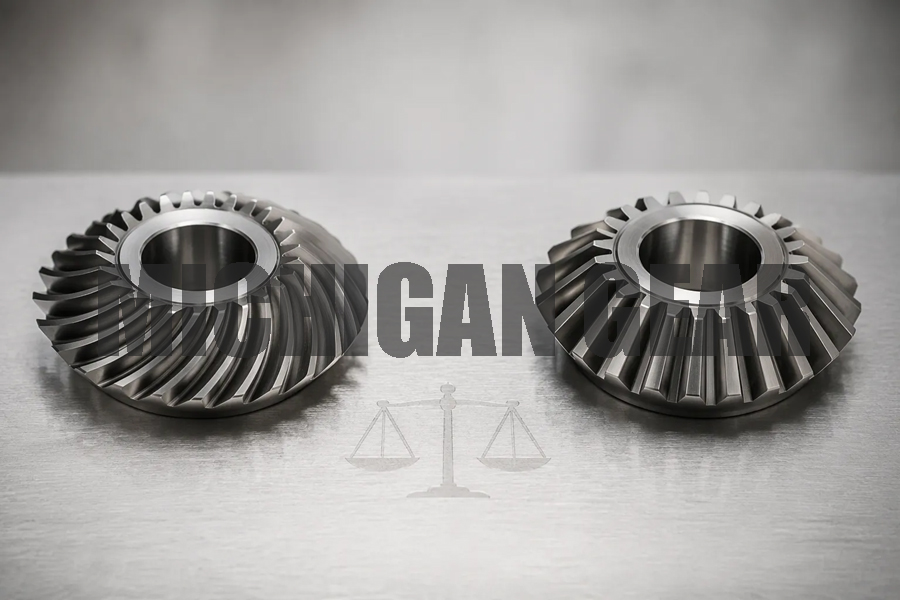
Begin with how your machine runs, not with a gear type you already like. PairGears treats the choice as a simple match between what you need and the gear type. High speed, heavy load, and tight noise limits point to the curved-tooth design. Low to medium speed, moderate load, and looser noise limits point to the straight-tooth design.
| Key Requirement | Choose Straight Bevel | Choose Spiral Bevel |
|---|---|---|
| Speed | Low to medium speed | High speed |
| Load capacity | Moderate load | High load |
| Noise control | Not a priority | Low NVH required |
| Cost sensitivity | Lower cost | Higher cost |
The tooth shape is the reason why. PairGears explains that curved teeth meet little by little and run smoothly. That slow contact spreads the load more evenly and lowers sudden forces. So a spiral bevel gear works well for high speed and high torque. Straight teeth meet more suddenly, so noise goes up as speed goes up. PairGears notes this makes straight bevel gears a weaker fit for quiet, high-speed work.
Set a speed limit for your own design. Cigarette Machinery reports that spiral bevel gears stay smooth above 300 rpm and up to several thousand rpm. The same source cites a noise drop of 40–60% against straight bevel gears during high-speed running. If your drive runs below that range and noise is okay, the straight type is still a choice.
Budget and Typical Use Cases
Now weigh cost against how hard the gear works. HLC Metalparts calls straight bevel gears the budget option for on-and-off duty. Spiral bevel gears cost more and suit steady, nonstop duty. PairGears advises you to compare the full manufacturing needs, not just the unit price. Material, heat treatment, accuracy, and quantity all change the final number.
Typical uses make the split clear. Cigarette Machinery lists tractor PTO drives and seeder corner drives in farm machinery, plus hand-crank drills, manual winches, low-speed conveyors, and cost-sensitive industrial gearboxes. These drives run slowly, carry moderate loads, and accept more noise. PairGears puts auxiliary drives and low-speed gearboxes in the same group.
The curved-tooth side covers heavier work. Cigarette Machinery names automotive differentials, heavy-duty industrial gearboxes, robotic joint drives, printing machinery, and aerospace and defense systems. PairGears adds automotive transmissions, high-speed gearboxes, and precision drives in EVs. These units run nonstop and do not forgive noise and vibration.
Match the gear to the job, and the choice becomes clear. A farm gearbox on a tight budget rarely needs the premium option. A nonstop EV drive rarely gains from the budget one. Write down your speed, load, noise target, and budget before you ask for quotes. That short list gives any supplier enough to suggest a fit.
Interchangeability and Replacement
Can You Swap One Type for the Other?
Most of the time, no. Wenlio says that matching tooth count or gear ratio does not make two bevel gears interchangeable. A straight bevel gear usually cannot directly replace a spiral bevel gear. The same rule works in reverse. Do not assume two 1:1 bevel gears make a correct miter pair. Also, do not swap a hypoid gear for an intersecting-shaft bevel gear just because the ratio matches.
Straight bevel gears give you more room to swap. Gear Technology explains that a full exchangeability exists between straight bevel gears with a straight root line and Coniflex gears with a curved root line. You must still adjust the tooth contact away from the tooth boundaries.
In the case of straight bevel gears, it was explained that a full exchangeability between straight bevel gears with a straight root line and Coniflex gears with a curved root line is given. However, the tooth contact must be adjusted to be away from the tooth boundaries.
Spiral bevel gears need much more care. Gear Technology notes that the cutter diameter, the spiral angle, and the manufacturing method must match the original parts. Face hobbing and face milling do not interchange with each other. Generated gears cannot be replaced with nongenerated (Formate) gears. With face hobbing, the number of cutter starts must also match the original method. In critical cases, you measure the damaged gear with a coordinate measurement machine and rebuild the correct surface form through reverse engineering.
Before you order any replacement, go through a full checklist. Wenlio recommends that you verify:
●Tooth geometry
●Shaft angle
●Mounting distance
●Mating gear data
●Spiral hand
●Backlash
●Contact pattern
For existing equipment, review the complete gear pair instead of copying a single worn part. That habit protects performance and saves you a second teardown.
Your machine’s speed, load, noise limits, and budget decide the gear type. Wenlio notes that straight bevel gears fit low to medium speed, moderate load, and cost-sensitive projects. A spiral bevel gear suits higher loads, smoother running, and stricter noise limits. Wenlio also reports a cost premium of 1.2 to 1.5 times for the spiral type at the same size.
Both types have real uses. The better gear is the one that fits how your machine runs, not the one that wins a general comparison. Bring your speed, load, noise target, and budget to a gear supplier. That supplier can then suggest a fit made for your machine.
FAQ
At what speed should you switch from straight to spiral bevel gears?
Spiral bevel gears stay smooth above 300 rpm and up to several thousand rpm. Straight bevel gears fit drives under 1,000 rpm. If your machine runs slowly and tolerates some noise, the straight type still works well.
How much more torque can a spiral bevel gear carry?
At the same pitch, module, and material, a spiral bevel gear carries about 30–50% more torque than a straight bevel gear before failure. Gradual tooth contact spreads the load across two or more teeth at once.
How much more does a spiral bevel gear cost?
Expect a cost premium of 1.2 to 1.5 times for the spiral type at the same size. Matched pairs and complex cutting drive that price up. Compare total cost of ownership, not just the unit price.
Can you replace one spiral bevel gear on its own?
No. Spiral bevel gears come as matched sets. You must replace the pair together. Straight bevel gears give you more freedom. You can swap a single gear when key parameters such as module and pressure angle match.
Do spiral bevel gears need extra bearing support?
Yes. The helix angle creates more axial thrust on the bearings. Plan for extra support structures in your design. Straight bevel gears carry a moderate thrust load and ask less of your bearing arrangement.
Post time: Nov-04-2026