


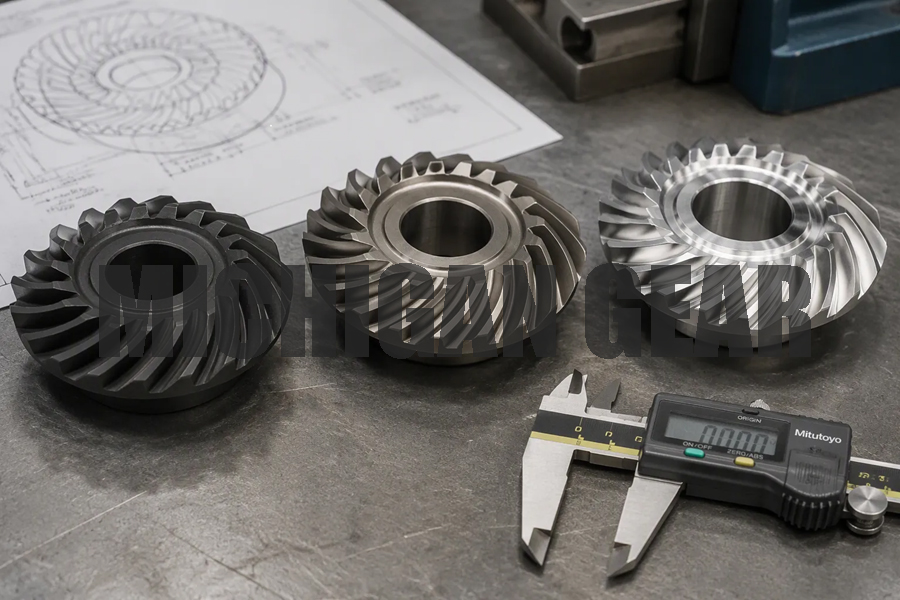
No single material wins for every spiral bevel gear. Your best choice depends on load, heat treatment, cost, and working conditions. This guide compares three common candidates: 20CrMnTi, 42CrMo, and stainless steel. Each one fits a different application zone. 20CrMnTi suits high-load wear resistance, 42CrMo delivers strength and toughness, and stainless steel handles corrosive settings. The comparison table below summarizes hardness, strength, wear resistance, corrosion resistance, heat treatment, machinability, typical applications, and cost side by side. Per-material sections then explain the heat treatment and trade-offs behind each option. Use both to match a material to your specific operating demands.
Key Takeaways
●No single material works best for every spiral bevel gear.
●Choose 20CrMnTi for high-load, high-wear applications.
●Pick 42CrMo for high strength and toughness.
●Use stainless steel in corrosive environments.
●Match the material to your load, environment, precision, and cost.
Spiral Bevel Gear Materials Compared
Key Properties Side by Side
The table below puts 20CrMnTi, 42CrMo, and stainless steel side by side across the properties that matter most for gear design. Hardness figures come from recommended heat treatments for each grade. Strength, wear resistance, and corrosion resistance appear as relative ratings, because absolute values vary with heat treatment, section size, and supplier. Cost ratings reflect typical market pricing, not a quote for your order quantity. You can use the table to screen candidates quickly before you dig into the per-material sections. Use it as a screening tool, not a final answer.
| Property | 20CrMnTi | 42CrMo | Stainless Steel |
|---|---|---|---|
| Hardness after heat treatment | HRC 58–62 surface, HRC 32–40 core (carburizing + quenching) | HRC 50–58 (induction hardening); HRC 28–35 (quench + temper) | HV 600–1000 with nitriding |
| Strength | High core toughness with hard case | High, uniform through the section | Moderate |
| Wear resistance | Excellent under heavy loads | Good, lower surface hardness than case-hardened grades | Moderate |
| Corrosion resistance | Low | Low | High |
| Heat treatment | Carburizing + quenching | Through-hardening, induction hardening | Nitriding optional |
| Machinability | Good before hardening; finishing needed after | Good | Good |
| Typical applications | High-load, high-wear gearboxes and drivetrains | High-strength gears and shafts in heavy equipment | Wet, humid, chemical, and food-processing settings |
| Cost | Moderate | Moderate | Higher |
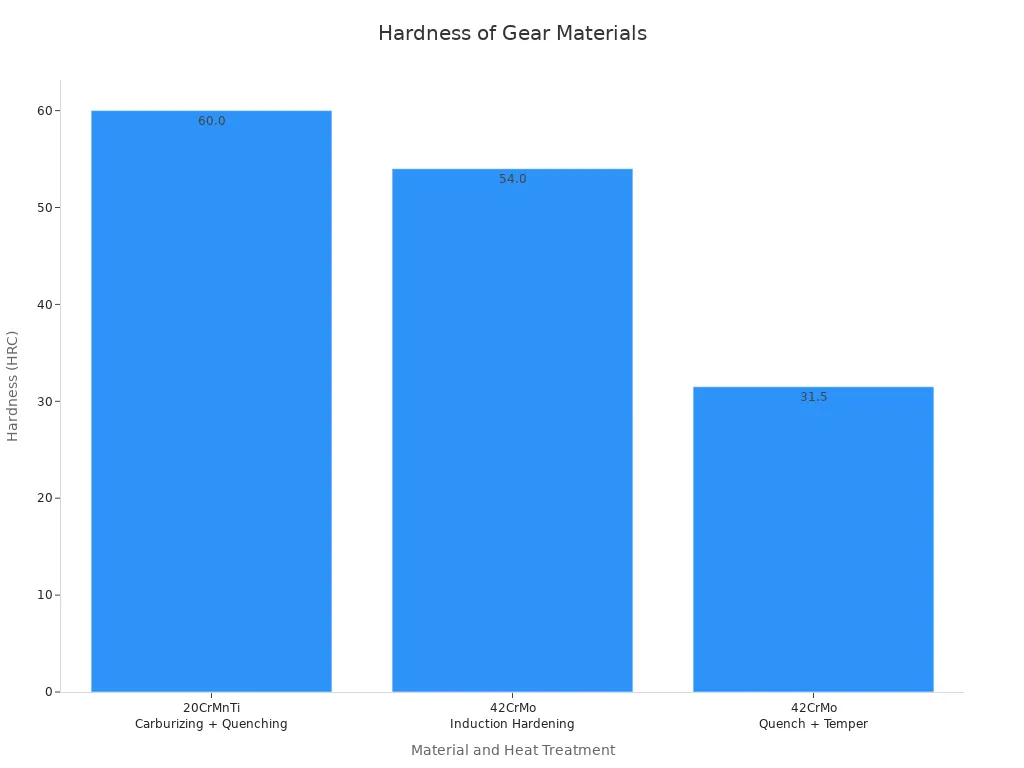
The hardness rows deserve a closer look. Gas carburizing and quenching give 20CrMnTi a surface of 58–62 HRC over a core of 32–40 HRC, with an effective case depth of 1.2–2.5 mm. That combination suits high-impact, high-torque duty. Forged 42CrMo with quenching and tempering plus tooth induction hardening reaches 50–55 HRC, which provides superior fatigue strength for large girth rings. Nitriding lifts stainless steel to HV 600–1000, a useful range for precision and corrosive service.
Spiral bevel gears run smoother than straight-tooth designs. Their curved teeth enter mesh gradually, so they lose less torque to friction, generate less heat, and carry lower overheating risk. Material selection should therefore favor grades that handle smooth, high-load operation without distortion or surface breakdown.
Spiral bevel gears are generally quieter than straight bevel gears: their curved teeth enter mesh more gradually, reducing harsh tooth impact, vibration, and noise — provided the gear pair is properly manufactured and assembled. They also share load across more than one tooth surface region, improving smoothness, load stability, and service life, which is why they are favored where noise and vibration matter more than lowest initial cost.
How to Read the Comparison
Treat the table as a starting point, not a verdict. A high hardness number does not guarantee a long service life if the core lacks toughness. A corrosion-resistant grade does not suit a heavily loaded gearbox just because it resists rust. Read each row against your own duty cycle. Check the load profile first, then the environment, then the precision class your application demands. Compare the cost column last, once the technical fit is clear. The bar chart above makes the hardness gap easy to see at a glance, but hardness alone never decides the case. The final choice always depends on the application, and your supplier can validate it against real test data.
20CrMnTi: Case-Hardening Steel
Properties and Heat Treatment
20CrMnTi is a case-hardening steel. You choose it when a gear needs a hard, wear-resistant surface over a tough core. The carburizing and quenching process delivers that combination. Carbon diffuses into the outer layer, and the subsequent quench hardens the case while the core stays ductile.
The heat treatment produces measurable results. You can verify them with standard shop tests.
| Parameter | Specification | Measurement Method |
|---|---|---|
| Surface hardness (tooth flanks and tips) | 58–64 HRC | Rockwell tester with flat anvil; test at least three teeth, two positions per flank |
| Core hardness | 33–48 HRC | Sectioned tooth or separately processed test coupon from same furnace load |
| Effective case depth | 1.2–1.6 mm | Transverse section, etch, measure depth from surface to 550 HV boundary |
Case depth deserves your attention. A depth below 1.2 mm risks pitting in service. Excessive depth beyond 1.6 mm may cause brittleness and spalling. Both failure modes shorten gear life, so you should specify the range and confirm it on a test coupon.
Advantages, Limits, and Applications
20CrMnTi is a commonly used material for spiral bevel gear production, and researchers study its wear performance at the microstructure level. The hard case resists wear under heavy loads, and the tough core absorbs impact without cracking. This balance suits demanding duty cycles.
The process has limits you should plan for. Carburizing and quenching can distort the part, so you need post-heat-treatment finishing to restore tooth accuracy. Budget for that step in both cost and lead time.
Typical applications include high-load, high-wear gearboxes and drivetrains. You will find this grade in equipment that runs under continuous torque and needs a long service interval between rebuilds.
42CrMo: Through-Hardening Steel
Properties and Heat Treatment
42CrMo is also known as 4140, and it is an alloy steel often used for gears that need high tooth strength and low tooth wear. Through-hardening gives the part uniform hardness through the section. You get good strength and toughness at the same time, and the grade responds to heat treatment better than plain carbon steels do.
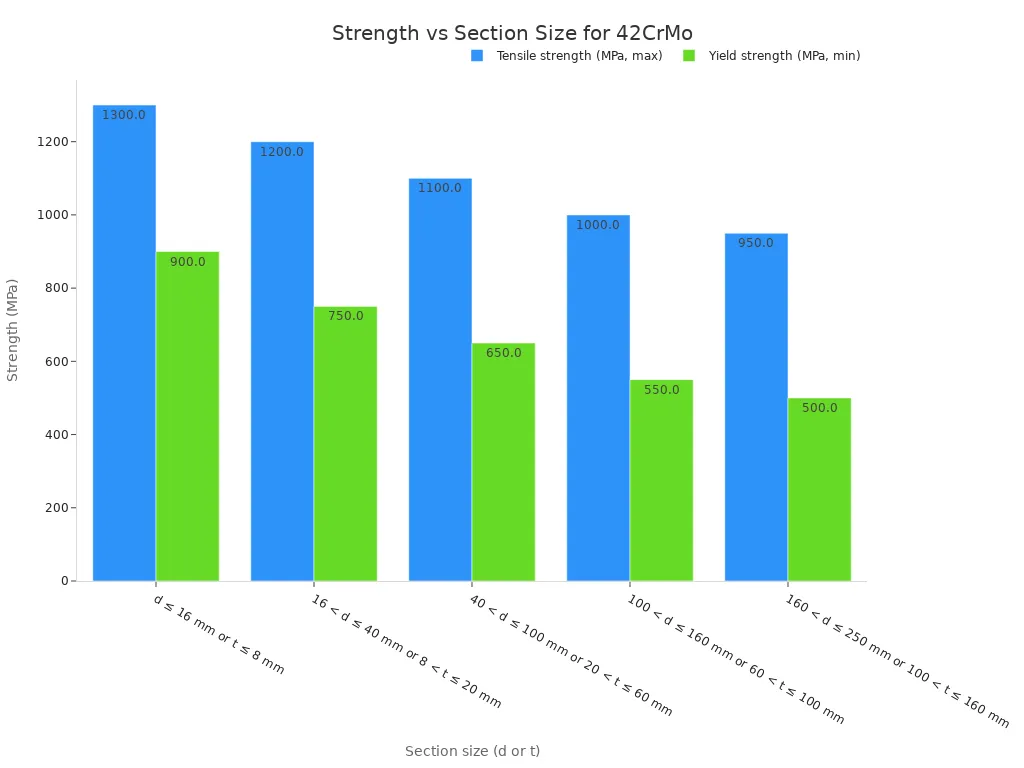
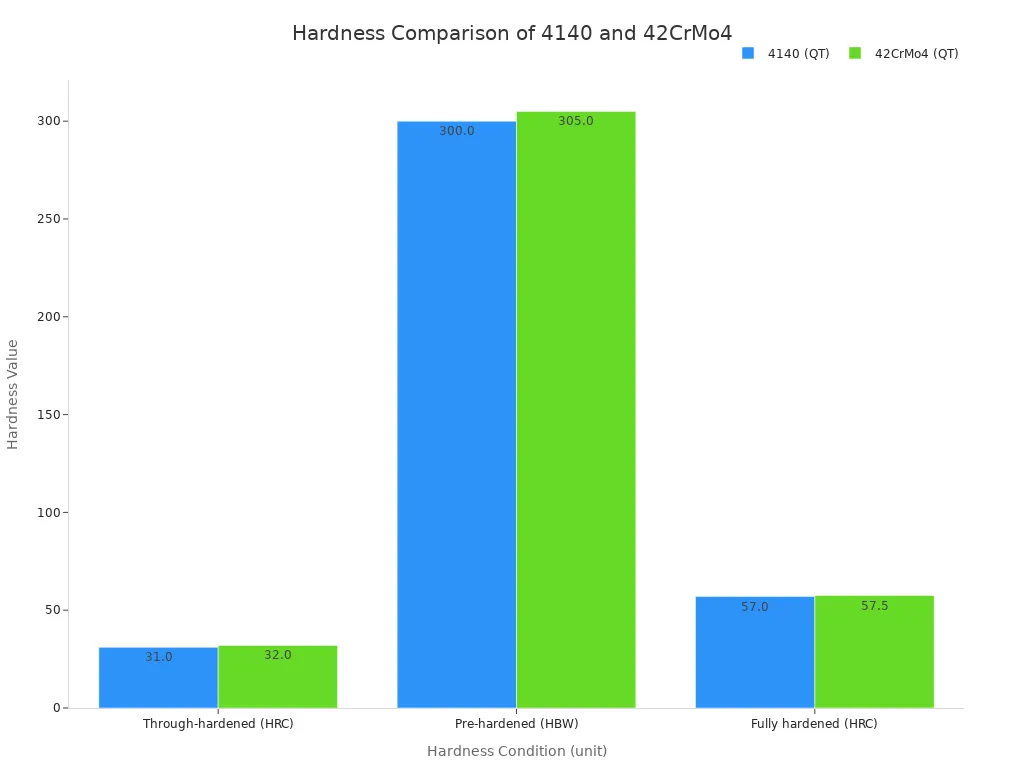
Quenching and tempering set the final properties. Typical results for 4140 and 42CrMo4 fall in the 28–36 HRC range, with tensile strength from 750 to 1,300 MPa depending on wall thickness. Section size matters, so check your part against the size bands before you finalize the spec.
| Section size (d or t) | Tensile strength (MPa) | Yield strength (MPa, min) | Elongation (%, min) |
|---|---|---|---|
| d ≤ 16 mm or t ≤ 8 mm | 1,100–1,300 | ≥900 | ≥10 |
| 16 < d ≤ 40 mm or 8 < t ≤ 20 mm | 1,000–1,200 | ≥750 | ≥11 |
| 40 < d ≤ 100 mm or 20 < t ≤ 60 mm | 900–1,100 | ≥650 | ≥12 |
| 100 < d ≤ 160 mm or 60 < t ≤ 100 mm | 800–1,000 | ≥550 | ≥13 |
| 160 < d ≤ 250 mm or 100 < t ≤ 160 mm | 750–950 | ≥500 | ≥14 |
Advantages, Limits, and Applications
42CrMo shows consistently higher tensile strength than 4140 across tempering temperatures. Its greater hardenability and fatigue resistance let it carry high-cycle loads and harsh conditions. That makes it a strong fit for heavy-duty parts such as ring gears, shafts, and drilling tools under high torque and impact.
Know where the grade fits. Quenched and tempered 42CrMo sits at roughly 220–300 HBW, which suits general medium- to low-speed duty with moderate strength and accuracy demands. A case-hardened spiral bevel gear reaches above 55 HRC and about 425 MPa surface fatigue limit, while quenched and tempered 42CrMo lands near 29 HRC and about 199 MPa. Match the process to the load, and the grade performs well.
Typical applications include high-strength, high-toughness gears and shafts in industrial and heavy equipment. Induction hardening lifts the tooth surface when your duty cycle calls for it.
Stainless Steel: Corrosion Resistance
Properties and Heat Treatment
Stainless steel earns its place through a protective chromium oxide layer. This film blocks rust and chemical attack, and it renews itself if scratched. You get moderate strength and easy machinability in return. Grade choice matters, so compare the common options before you specify.
| Grade | Tensile Strength (MPa) | Yield Strength (MPa) | Hardness |
|---|---|---|---|
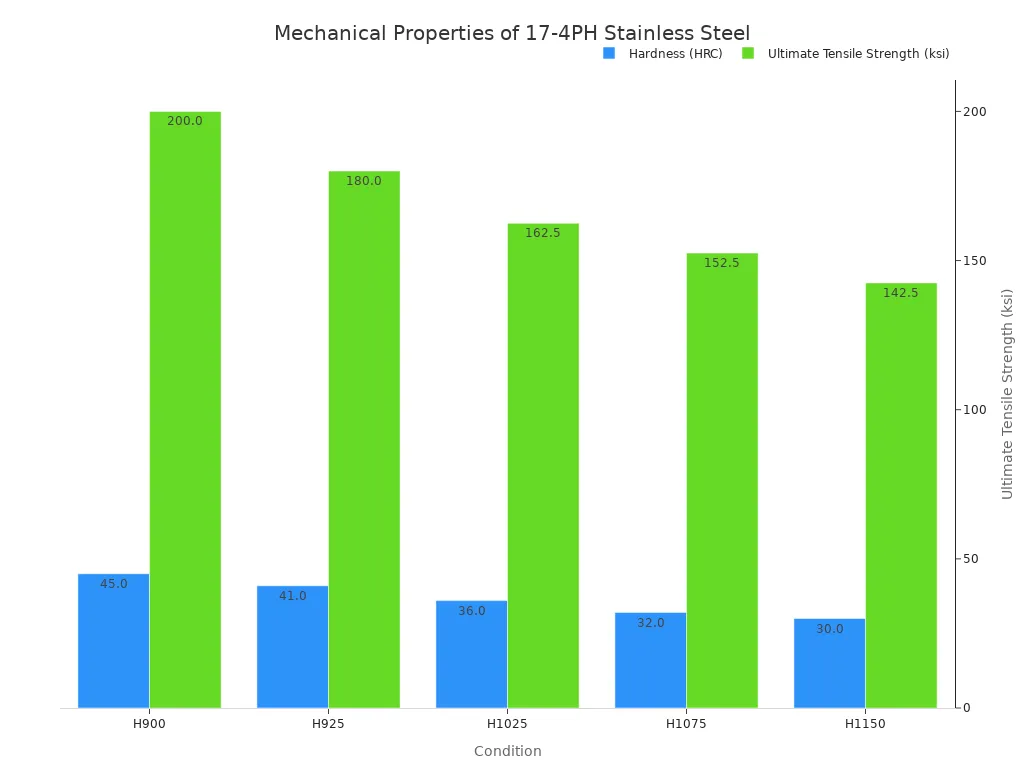
| 17-4 PH | 1070–1310 | 1000–1170 | 35–45 HRC |
| 304 | 515–620 | 205–310 | 88 HRB |
| 316 | 485–620 | 170–310 | 95 HRB |
| 15-5 PH | 1070–1270 | 1000–1140 | 35–45 HRC |
Precipitation-hardening grades respond well to heat treatment. You can tune 17-4 PH across a wide window, from H900 at 482°C for one hour down to H1150 at 621°C for four hours. Hardness falls from 44–46 HRC to 28–32 HRC across that range, and tensile strength follows the same trend.
Advantages, Limits, and Applications
Rust resistance is the headline benefit. Stainless steel bevel gears handle salt spray, constant humidity, and daily washdown without protective coatings. Boat lifts and dock equipment run for years with no visible corrosion. In chemical washdown, the passive layer removes the need for painting, plating, or oil baths. Food processing lines shrug off daily hosing with water and sanitizers.
Austenitic stainless steels offer good corrosion resistance, making them suitable for gears in marine and corrosive environments.
Know the boundaries. Stainless steel generally offers lower strength and wear resistance than alloy steels, and it costs more. Specify it for moderate torque rather than very high-load duty. Typical applications include food and beverage machinery, pharmaceutical equipment, marine and offshore settings, agricultural machinery exposed to fertilizers and moisture, and automotive test tunnels with rain and saltwater spray. A stainless Spiral Bevel Gear fits these wet, humid, chemical, and hygienic environments well.
Spiral Bevel Gear Selection Criteria
Load, Speed, and Precision
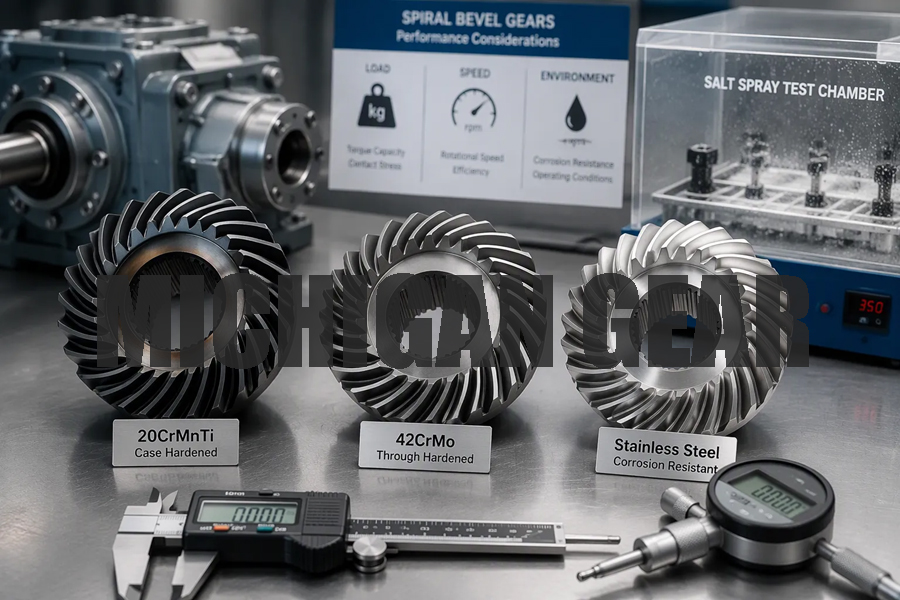
Load capacity comes first. You need to know the peak torque and the shock loads your gearbox will see in service. A high-load, high-wear duty cycle points toward a case-hardened grade with a hard surface and a tough core. A gear that runs at high torque with frequent starts and stops needs toughness in the core, not just hardness at the surface. A moderate load with steady speed opens more options, including through-hardened and stainless grades. Speed matters too. Higher speeds raise heat and demand tighter balance and better surface finish. Precision requirements then set the finishing process. Ground gears reach a higher accuracy class than unground ones, and the gap is worth planning for. Write down the duty cycle before you compare grades.
Standard (unground) spiral bevel gears in 20CrMnTi, 42CrMo, and stainless steel typically hold DIN 8 / AGMA 10. With grinding, the same material set can reach DIN 4-5 / AGMA 14.
| Attribute | Standard Grade | High-Precision Grade |
|---|---|---|
| Accuracy Standard | DIN 8 / AGMA 10 | DIN 4-5 / AGMA 14 |
| Materials | 20CrMnTi (SCM420), 18CrNiMo7-6, SAE 8620, 42CrMo (AISI 4140), SUS 304/316, Bronze C90700, Acetal/Nylon | (same material set) |
Gear Quality: DIN 3–4
That figure comes from 5-axis CNC machining of Gleason/Klingelnberg profiles with contact pattern verification and lapping. Ground gears are also quoted at precision grade 4 under GB11365-89, which the manufacturer states is roughly equivalent to DIN 4-5 / AGMA 10-11. Match the precision class to the application before you pick a material, because the finishing step drives both accuracy and cost. A precision class tighter than the application needs adds cost without adding value.
Environment and Cost
The working environment narrows the field fast. Corrosive atmospheres call for stainless steel or protective coatings. High temperatures require special lubricants and heat-treatment considerations. Contaminants such as dust and grit accelerate wear, so you pair hard, tough materials with effective seals and filters.
●Corrosive atmospheres: specify stainless steel or apply protective coatings.
●High temperatures: require special lubricants and heat-treatment considerations.
●Contaminants: considered alongside humidity and temperature as a driver of gear longevity and material selection.
Operating environment and conditions must be taken into account when selecting gear material: temperature, humidity, corrosive agents, and contaminant exposure can significantly affect material performance.
Harsh coal-mine conditions illustrate the point. High impact loads, excessive humidity, and dust all accelerate wear on bevel gears. You mitigate dust ingress with effective seals and filters on the reducer, control humidity with desiccant breathers, and select materials with high hardness and toughness, such as case-hardened steels. Seals and breathers cost far less than a premature rebuild. Humidity and temperature belong in the same review, because they interact with contaminants to shorten gear life.
Cost closes the loop. Compare the total cost of material, heat treatment, finishing, and expected service life, not just the price per kilogram. Alloy steels such as 42CrMo generally offer better strength and heat-treatment response than carbon steels, but the choice still depends on the application. No single material is best for every spiral bevel gear job. Weigh load, heat treatment, cost, and working conditions together before you commit, and confirm the final call with your supplier. Ask for test data on case depth, core hardness, and surface hardness for the specific heat-treatment lot. That data lets you verify the process, not just the grade name.
Recommendation Matrix by Application
Which Material Fits Which Use Case
The matrix below maps four common application profiles to the material that fits each one best. Every entry draws on the properties covered earlier in this guide, so you can trace each recommendation back to a hardness, strength, or corrosion figure you have already seen.
| Application Profile | Best-Fit Material | Why It Fits |
|---|---|---|
| High-load wear | 20CrMnTi | Carburized case at 58–62 HRC over a tough core at 32–40 HRC resists wear and impact together |
| High strength and toughness | 42CrMo | Uniform through-section hardness, with tensile strength from 750 to 1,300 MPa depending on section size |
| Corrosive environment | Stainless steel | Chromium oxide layer resists rust, humidity, and chemical washdown; nitriding lifts surface hardness to HV 600–1000 |
| General-purpose, cost-sensitive | 42CrMo (quenched and tempered) | Moderate cost with good machinability and dependable strength for moderate duty |
Read the first row as your starting point for continuous-torque gearboxes and drivetrains. The hard case carries the contact load, and the ductile core absorbs shock. Plan for post-heat-treatment finishing, because carburizing can distort the part.
The second and fourth rows overlap on purpose. Quenched and tempered 42CrMo serves general-purpose duty well, and induction-hardened 42CrMo steps up to heavier tooth loads when your duty cycle demands it. One grade covers a wide band of applications, which simplifies your inventory and your supplier qualification.
Choose stainless steel when moisture, salt, or sanitizers dominate the duty cycle. It trades some load capacity for freedom from coatings and oil baths. For a food line or a dock lift, that trade pays for itself.
No row in this matrix outranks the others. Each material wins inside its own zone. Confirm your pick against real load data and your supplier’s test results before you release the drawing.
No universal ranking settles the material question for a Spiral Bevel Gear. Your application decides. 20CrMnTi fits high-load, high-wear duty best, thanks to its hard case and tough core. 42CrMo delivers strength and toughness across the section. Stainless steel wins wherever corrosion dominates.
Weigh load, environment, precision, and cost together before you commit. Then confirm the choice with your supplier. Pin down material grade, heat treatment method, surface hardness, effective case depth, and core hardness in the RFQ, not just the material name. A first-article order with independent incoming inspection closes the loop. That step verifies the gear against every drawing parameter before production begins.
FAQ
Which material should you pick for a high-load, high-wear gearbox?
Choose 20CrMnTi for this duty. Carburizing and quenching give it a surface of 58–62 HRC over a core of 32–40 HRC. The hard case resists wear, and the tough core absorbs shock. Plan for post-heat-treatment finishing, because the process can distort the part.
Can stainless steel gears handle heavy torque?
Stainless steel offers moderate strength and wear resistance. Reserve it for moderate torque duty in wet, humid, or chemical settings. For very high-load applications, an alloy steel such as 20CrMnTi or 42CrMo fits better. Match the grade to the load before you commit.
Does 42CrMo need case hardening?
Not always. Through-hardening gives 42CrMo uniform strength and toughness through the section, with tensile strength from 750 to 1,300 MPa depending on section size. Add induction hardening when your duty cycle calls for a harder tooth surface. The process follows the load, not the grade name.
How much does heat treatment change the final gear?
Heat treatment drives the properties you actually get. The same grade can land near 29 HRC quenched and tempered or above 55 HRC case hardened. Specify surface hardness, effective case depth, and core hardness in your RFQ, then verify them on a test coupon.
Can you reach tight precision with any of these materials?
Yes. Standard unground gears in all three materials typically hold DIN 8 / AGMA 10. Grinding lifts the same material set to DIN 4-5 / AGMA 14. Match the precision class to your application, because a tighter class than you need adds cost without adding value.
Post time: Oct-28-2026