


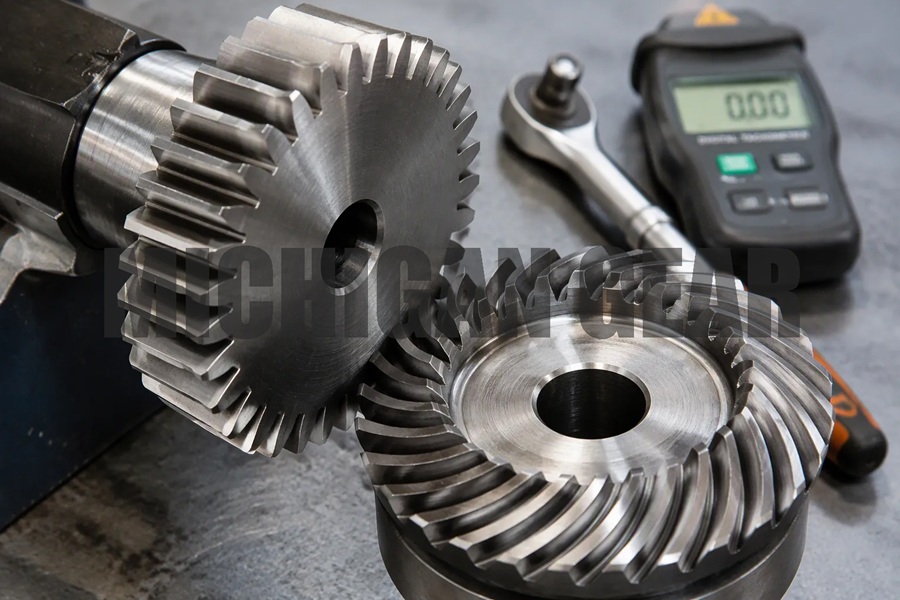
Carburizing followed by quenching and tempering is the heat treatment commonly used and generally best for spiral bevel gears. This process gives you a hard, wear-resistant surface backed by a tough core. The result is a gear that resists wear and handles heavy loads without cracking.
You get a longer service life from this treatment. Wear resistance improves, bending and contact fatigue strength rise, and distortion stays under control. These gains matter because spiral bevel gears carry high sliding and bending loads in every mesh cycle.
The best choice still depends on your load, speed, precision needs, and budget. You will see how the main options compare and where each one fits.
Key Takeaways
●Carburizing is the best heat treatment for most spiral bevel gears. It creates a hard surface and a tough core.
●Carburizing makes gears last longer. They resist wear and handle heavy loads without cracking.
●Choose nitriding for precision gears. It keeps dimensions stable and suits lighter loads.
●Pick induction hardening for very large gears. It is fast and economical.
●Always check hardness, case depth, and dimensions after treatment. These checks ensure quality and long service life.
Why Heat Treatment Matters for Spiral Bevel Gears
Service-Life Factors That Matter
A spiral bevel gear uses curved teeth that mesh gradually. Contact starts at one end of the tooth and rolls across the face. This gradual mesh softens impact and cuts vibration, which is why these gears run quietly in axles and drives. The same curved contact still produces high sliding speeds and heavy bending loads at the tooth root. Heat treatment decides whether the gear survives that load or fails early.
Three yardsticks run through this post. Wear resistance is the surface’s ability to resist material loss as teeth slide against each other. Fatigue strength comes in two forms: bending fatigue is the root’s ability to resist cracking under repeated load, and contact fatigue is the surface’s ability to resist pitting under repeated pressure. Dimensional stability is the gear’s ability to hold its shape and tolerances through treatment and service.
How Treatment Changes Gear Properties
Heat treatment alters the steel’s microstructure, and that change drives every property above. A hard surface layer resists sliding wear and contact pitting. A tough core absorbs bending stress and stops cracks from spreading. Controlled heating and cooling also limit warping, which protects the gear’s accuracy.
You cannot get all three benefits from one uniform structure. A gear that is hard all the way through becomes brittle. A gear that is tough all the way through wears quickly. The right process builds a hard case over a tough core, and the next section compares the methods that achieve this balance for a spiral bevel gear.
Comparing Four Heat Treatments
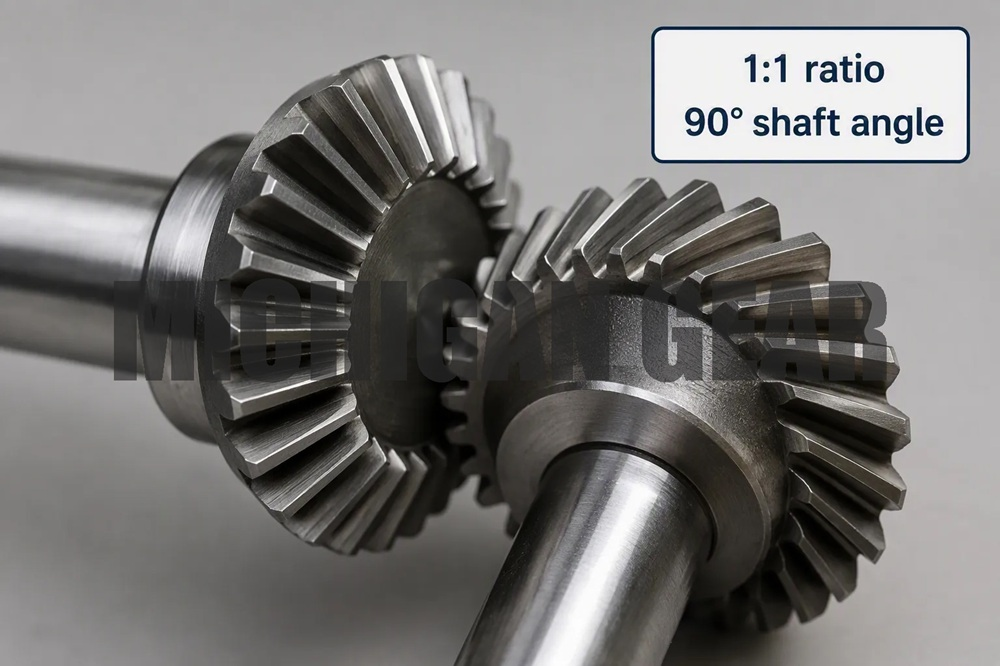
Carburizing, Nitriding, and Induction Hardening
Case depth is the thickness of the hardened surface layer, measured from the tooth surface inward. It sets how much wear reserve the tooth carries and how well it supports the load above the softer core. The table below compares the four methods on the properties that decide service life.
| Method | Surface hardness | Case depth | Core toughness | Distortion risk | Cycle time | Relative cost |
|---|---|---|---|---|---|---|
| Carburizing + quench | High | Up to about 10 mm; commonly 0.005–0.25 in. | High | Medium, reducible with low-pressure carburizing and gas quench | Long | Higher |
| Nitriding | High | 0.008–0.025 in. | High, unchanged by treatment | Very low | Long, roughly 10–80 hours | Moderate to high |
| Induction hardening | High | Shallow, locally formed | High | Low to medium | Short | Economical, especially on large gears |
| Through hardening | Uniform, lower at surface | None | Moderate | Low | Short | Lowest |
A typical carburizing cycle runs in four stages. You heat the gears to about 925°C in a carbon-rich atmosphere, hold for carburizing, allow a diffusion period so carbon spreads inward and the gradient stays smooth, pre-cool to the quench temperature, then quench and temper. The quench is where distortion begins, because the phase change from austenite to martensite shifts dimensions.
Nitriding suits precision gears. It runs at much lower temperatures and produces no austenite-to-martensite transformation, so dimensional stability stays high. Induction hardening heats only the tooth contour and quenches it, which makes it a fast, economical route to a hard surface.
Through Hardening and Method Fit
Through hardening hardens the whole section, so no distinct case forms and the hardness gradient runs from surface to core. It is simple, fast, and economical, and you can perform it before or after tooth cutting. A properly carburized gear handles 30 to 50 percent more load than a through hardened gear, which is why carburizing dominates high-load spiral bevel gear work.
Method fit follows size and volume. Carburizing covers a wide range of gear sizes and suits high-volume production. Nitriding favors finished, precision gears at lower throughput. Induction hardening pays off on very large gears, where contour heating costs less than building oversized coils, and on higher volumes that reward short cycles.
How Each Method Affects Service Life
Wear Resistance and Fatigue Strength
Wear resistance tracks surface hardness and case depth together. Carburizing delivers both in generous measure. Its case can reach about 10 mm, and common practice runs from 0.005 to 0.25 in. That deep, hard layer gives the tooth a large wear reserve. It also spreads contact pressure over a wider zone below the surface, which raises contact fatigue resistance and delays pitting. The tough core backs the case and blunts bending fatigue at the root. A properly carburized gear handles 30 to 50 percent more load than a through hardened gear, so you get more service life from the same tooth size.
Nitriding produces a very hard, thin case of 0.008 to 0.025 in. Wear resistance at the surface is excellent. The shallow case offers less support for heavy contact loads, so nitriding fits lighter or more precise duty better than severe shock loading. Induction hardening creates a hard contour layer with a short cycle. It resists surface wear well and suits large teeth, where a full furnace cycle is impractical. Through hardening leaves a uniform structure with lower surface hardness. It resists wear least among the four, yet it handles moderate loads at the lowest cost.
Dimensional Stability and Cost
Distortion drives your finishing budget. Carburizing carries medium distortion risk, because the austenite-to-martensite change during quenching shifts dimensions. Low-pressure carburizing with a gas quench reduces that risk. You still plan a finishing pass to restore tolerance after treatment. Nitriding avoids the phase change entirely, so dimensional stability stays very high and you can treat finished gears. Induction hardening keeps distortion low to medium and localizes it at the tooth. Through hardening distorts little and needs no case-depth control.
Cost follows cycle time and fixturing. Carburizing runs long cycles at higher relative cost, and high-volume production spreads that cost across many parts. Nitriding takes roughly 10 to 80 hours, so it carries moderate to high cost and suits lower throughput. Induction hardening is economical, especially on large gears, because you heat only the contour. Through hardening is the lowest-cost route. Weigh each option against the load a spiral bevel gear must carry and the tolerance band it must hold.
Choosing the Right Treatment
Matching Heat Treatment to Spiral Bevel Gear Applications
You can narrow the choice with a short checklist. Start with load: heavy shock duty points to carburizing, while lighter duty opens the door to nitriding or through hardening. Check speed next, because fast running raises contact fatigue demands. Note gear size, since very large teeth favor induction hardening. Confirm the precision class, because tight tolerance bands reward nitriding’s dimensional stability. Weigh production volume and budget last, since long furnace cycles pay off only when volume spreads the cost.
Distortion deserves its own line on that checklist. Heat treatment shifts dimensions, and even small warping can push a precision gear outside its tolerance band. Plan a finishing operation after treatment to restore tolerance. You then hold accuracy without scrapping an otherwise sound part.
Process Control and Quality Checks
Verification closes the loop. Hardness testing splits into surface hardness and core hardness, and it uses methods such as Rockwell, Vickers, and Brinell. Surface hardness confirms wear resistance, while core hardness confirms toughness. Excessive surface hardness without a tough core harms impact and fatigue resistance, so check both.
| Check | What It Confirms |
|---|---|
| Hardness testing | Surface hardness, core hardness, and heat-treatment condition |
| Case-depth measurement | Hardening layer depth and wear reserve |
| Dimensional inspection | Outer diameter, inner diameter, keyway width, tooth width, hole diameter, and total length against drawing specs |
Dimensional inspection verifies conformance to the drawing. It covers mounting dimensions, bore diameter, tooth thickness, face width, outside diameter, and overall geometry. You can measure with a CMM or by hand, and manual measurement often wins on efficiency and cost. Accurate dimensional control keeps the gear aligned in the transmission. Match the treatment to the application, then confirm the process with these checks.
Carburizing followed by quenching and tempering remains the best overall choice for most spiral bevel gears. It gives you the strongest balance of wear resistance, fatigue strength, and service life, with a hard case over a tough core.
Several factors can still shift your decision. Load level, precision requirements, gear size, distortion tolerance, and total cost each carry weight. A precision gear may favor nitriding, and a very large tooth may favor induction hardening.
Match the treatment to your application, then verify process control with hardness testing, case-depth measurement, and dimensional inspection. That approach protects both accuracy and service life.
FAQ
Why does carburizing beat the other methods for most spiral bevel gears?
It builds a deep, hard case over a tough core. Case depth can reach about 10 mm, and common practice runs from 0.005 to 0.25 in. That combination resists wear and pitting at the surface while the core blunts bending stress at the tooth root.
When should you pick nitriding instead?
Choose nitriding for precision gears. It runs at lower temperatures and skips the austenite-to-martensite change, so dimensional stability stays very high. You can treat finished parts. Its thin case of 0.008 to 0.025 in. suits lighter or more precise duty better than severe shock loading.
Can you eliminate distortion after heat treatment?
You can reduce it, not erase it. Low-pressure carburizing with a gas quench lowers the risk during the quench stage. Plan a finishing pass afterward to restore tolerance. Even small warping can push a precision gear outside its band.
How much more load can a carburized gear carry?
A properly carburized gear handles 30 to 50 percent more load than a through hardened gear. That extra capacity comes from the hard case and tough core working together, which is why carburizing dominates high-load spiral bevel gear work.
Which checks confirm the treatment worked?
Run three checks. Hardness testing confirms surface and core hardness. Case-depth measurement confirms the wear reserve. Dimensional inspection confirms outer diameter, bore, keyway width, tooth width, and total length against the drawing. Together they protect both accuracy and service life.
Post time: Oct-28-2026