


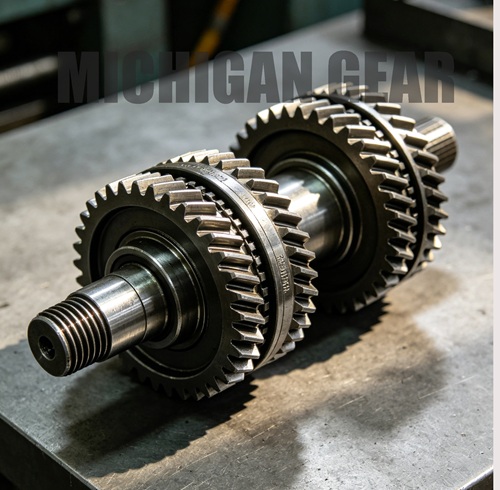
A cluster gear, also known as a compound gear or double gear, is a group of gears assembled on one shaft. This gear assembly helps transfer power and change speed in gearboxes. Cluster gears play a key role in compact machinery, offering smooth rotation and supporting stable, adjustable systems.
Key Takeaways
●Cluster gears are essential for transferring power and changing speed in machinery. They help improve efficiency and support smooth operation.
●Proper maintenance, including regular lubrication and inspection, is crucial for extending the life of cluster gears and preventing wear.
●Choosing the right cluster gear based on space, load, and environmental factors ensures reliable performance and enhances machine efficiency.
Cluster Gear Basics
A cluster gear, also known as a compound gear or double gear, is a group of gears assembled on one shaft. This gear assembly helps transfer power and change speed in gearboxes. Cluster gears play a key role in compact machinery, offering smooth rotation and supporting stable, adjustable systems.
Key Takeaways
●Cluster gears are essential for transferring power and changing speed in machinery. They help improve efficiency and support smooth operation.
●Proper maintenance, including regular lubrication and inspection, is crucial for extending the life of cluster gears and preventing wear.
●Choosing the right cluster gear based on space, load, and environmental factors ensures reliable performance and enhances machine efficiency.
Cluster Gear Basics
Structure and Components
A cluster gear is a group of gears mounted on a single shaft. This arrangement is also called a compound gear or double gear. The basic design allows several gears to work together, making the system more compact and efficient.
Cluster gears contain several important parts:
- Shaft: The central rod that holds all gears in place.
- Individual Gears: Multiple gears fixed along the shaft, each with a specific number of teeth.
- Bearings: These support the shaft and reduce friction during rotation.
- Housing: The enclosure that protects the gears and keeps them aligned.
The choice of material for cluster gears affects performance and durability. Here is a table showing common materials and their properties:
| Material | Key Properties | Best Applications |
|---|---|---|
| Alloy Steel (4140, 4340) | High strength, fatigue resistance, heat-treatable | Heavy-duty transmissions, industrial gearboxes |
| Carbon Steel (1045, 1060) | Good machinability, cost-effective, moderate wear | Automotive transmissions, power tools |
| Stainless Steel (304, 316) | Corrosion resistance, moderate strength | Marine, food processing, chemical industries |
| Case-Hardened Steel | Hard outer layer, tough core, excellent wear | High-precision gear systems, aerospace components |
| Bronze (C93200, C95400) | Low friction, good thermal conductivity | Worm gear pairs, low-speed high-torque uses |
Modern cluster gear design uses advanced manufacturing methods. Precision manufacturing creates gears with exact dimensions. 3D printing technology helps engineers make prototypes quickly and at lower cost.
How Cluster Gears Work
Cluster gears transfer power from one part of a machine to another. The gears on the shaft mesh with other gears in the system. This setup changes the speed and torque of the output.
The arrangement of gears within a cluster gear affects how power moves through the system. The following table explains key aspects:
| Aspect | Explanation |
|---|---|
| Power Distribution | The arrangement helps distribute input power effectively. |
| Radial Loading Reduction | The configuration reduces radial loading, improving durability and performance. |
| Speed Reduction & Torque | Allows for significant speed reduction while increasing torque, important for many applications. |
| Counterbalancing Forces | Planetary gear setups enable efficient power transmission by counterbalancing forces. |
| Cumulative Torque Generation | The design allows for cumulative torque generation, boosting output torque. |
| Gear Ratio Calculation | The speed reduction ratio depends on the number of teeth on the sun and ring gears. |
| Example of Application | Automobile transmissions use planetary gearing for effective power management. |
Cluster gear systems often use planetary arrangements. These setups show high efficiency, especially in mid-range gears. Energy loss is lower in these gears because meshing losses decrease. Efficiency peaks around 3000 rpm and 50% load.
Tip: Cluster gears are ideal for compact machinery. They allow multiple mechanisms to run from a single shaft, saving space and improving performance.
Recent advancements in cluster gear technology include:
- 3D printing for rapid prototyping.
- Precision manufacturing for high accuracy in standard and custom gears.
Cluster gear systems help machines run smoothly. They manage power, reduce energy loss, and support stable operation.
Uses and Benefits
Applications in Transmissions
Cluster gear plays a vital role in manual transmissions. It is often called a countershaft gear in this context. This gear assembly is present in both sliding-gear and constant-mesh transmission types. The cluster gear rotates whenever the clutch is engaged, even if the transmission is not in gear. This constant rotation helps transfer power smoothly and allows the driver to shift gears efficiently.
- Cluster gears are essential in manual transmissions.
- They support both sliding-gear and constant-mesh transmission systems.
- The gear rotates whenever the clutch is engaged.
Cluster gear helps manage speed and torque in vehicles. It allows for smooth gear changes and reliable power delivery. This makes it a key part of automotive engineering.
Other Machinery Uses
Cluster gear is not limited to automotive transmissions. It appears in many types of industrial and specialized machinery. The following table shows common application areas and their functions:
| Application Area | Function of Cluster Gears | Example System |
|---|---|---|
| Industrial Machinery | Flexible power transmission | Gearboxes in conveyors |
| Robotics | Precise motion control | Multi-speed robotic actuators |
| Power Tools | Speed and torque adjustment | Drills, grinders |
| Food Processing | Synchronized movement | Packaging equipment |
| Medical Devices | Drive multiple mechanisms | Healthcare machinery |
| Pumps | Efficient power transfer | Industrial pumps |
Cluster gear can drive two different mechanisms at the same time. This feature is useful in medical, office, industrial, and packaging equipment. The compact design allows for both inch and metric sizes on the same shaft, making it versatile for many systems.
- Gearboxes in conveyors
- Multi-speed robotic actuators
- Power tools and industrial machinery
- Food processing and packaging equipment
- Medical devices and healthcare machinery
- Pumps
Key Advantages
Cluster gear offers several important benefits for machinery and equipment:
Note: Cluster gear enables the driving of multiple mechanisms from a single input. This increases efficiency and saves space.
- Compact Design: Cluster gear allows engineers to fit more functions into a smaller space. This is important for modern machines that require high performance in limited areas.
- Load Distribution: In planetary gear systems, the load is shared among several gears. This increases torque capability and reduces wear.
- Versatility: The ability to drive different mechanisms at once makes cluster gear suitable for many industries.
- Reduced Wear: Multiple contact points in planetary arrangements distribute force evenly. This helps extend the life of the gear system.
- Smooth Operation: Cluster gear helps reduce energy loss and supports stable machine operation.
Cluster gear also impacts noise and vibration levels in machinery. Gear meshing can cause noise, known as gear whine, which ranges from 50 to 90 dB SPL. Proper design and maintenance can help minimize these effects, leading to quieter and more reliable machines.
Tip: Choosing the right cluster gear can improve machine performance and reduce maintenance needs.
Issues and Selection
Common Problems
Cluster gears face several challenges in daily operation. These problems can affect performance and lifespan.
- Problems with clutch operation often lead to gear failure. Using the wrong clutch type can damage the gear train.
- Synchronizer failures make shifting difficult and cause early wear on gear components.
- Inadequate lubrication or using the wrong lubricant reduces gear life and increases friction.
- Aggressive clutches, if not matched to the system, can shock the gear train and cause breakage.
Regular inspection helps catch these issues before they lead to major failures.
Maintenance Tips
Proper maintenance extends the life of cluster gears. Lubrication plays a key role in reducing friction and protecting against wear.
- Use the correct lubricant for your gear system. Too much lubricant can cause churning losses, while too little increases wear.
- Check lubricant levels often and replace old lubricant as needed.
- Monitor for signs of overheating or unusual noise, which may signal lubrication problems.
- Keep the gear housing clean to prevent contaminants from entering the system.
Tip: Understanding how lubricant moves inside the gearbox helps optimize performance and durability.
Choosing the Right Cluster Gear
Selecting the right cluster gear depends on several important factors:
- Space availability: Cluster gears work well in tight spaces.
- Environmental threats: Extreme temperatures, salt, or dust affect material choice.
- Noise and vibration: Helical gears reduce noise and vibration.
- Precision: High-precision jobs may need anti-backlash gears.
- Physical properties: Consider gear size, shape, number of teeth, speed, torque, and backlash.
The table below shows how load and speed influence gear selection:
| Criteria | Description |
|---|---|
| Load Requirements | Higher mechanical loads need larger gear modules for strength. |
| Speed Considerations | Smaller gear modules suit high-speed uses to lower noise and inertial forces. |
Careful selection ensures reliable operation and longer gear life.
Cluster gears improve efficiency and lubrication in gearboxes. They help machines run smoothly and support many applications, from vehicles to industrial tools. Advances in computer-aided engineering make design and analysis faster. Careful selection and regular maintenance keep cluster gears reliable and extend their service life.
FAQ
What is the main purpose of a cluster gear?
Cluster gear helps transfer power and change speed in gearboxes. It supports smooth operation and allows machines to work efficiently.
Where can cluster gear be found outside automotive transmissions?
Cluster gear appears in industrial machinery, medical devices, and packaging equipment. It drives multiple mechanisms and saves space.
How can you maintain cluster gear for longer life?
Regular lubrication and inspection prevent wear. Clean the housing and check for noise or overheating to keep cluster gear working well.
Post time: Apr-23-2026