


I learned the hard way that a cheap miter gear quote can cost far more than the part itself. One late shipment once stalled my entire assembly line for a week. Mismatched gear sets forced expensive rework. These failures trace back to one decision: the supplier.
How do I separate a reliable manufacturer from a risky one before I place an order? I built a 10-question framework for this exact purpose. Engineers and procurement teams can use it to vet suppliers fast. The right questions asked early save money, time, and frustration later. A wrong choice hurts your budget and your reputation.
Key Takeaways
●Ask 10 key questions to separate reliable miter gear manufacturers from risky ones.
●Choose a manufacturer that specializes in miter gears for consistent quality.
●Request inspection reports and material certifications to verify quality.
●Check heat treatment and matched-set capabilities to ensure performance.
●Watch for red flags like vague answers and missing documentation.
Why Miter Gear Specialization Matters
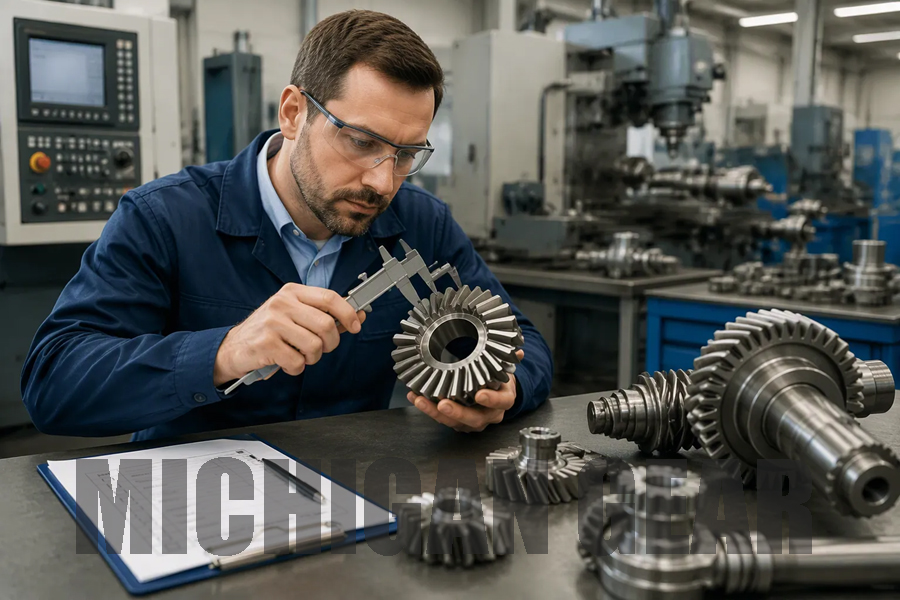
I see engineers assume any gear shop can produce a reliable miter gear. That assumption leads to expensive problems. Manufacturers who treat miter gears as a side product lack the specialized tooling and expertise needed for precision work. They cut bevel gears as filler between larger orders. The quality suffers because they do not invest in dedicated hobbing machines or inspection fixtures. I look for shops where miter gears are a core product. Those shops deliver consistent results and tighter tolerances.
Question 1: Do You Specialize in Miter Gears?
I start every conversation with this question. The answer reveals whether miter gear production is their priority or an afterthought. A specialist discusses tooth contact patterns, backlash control, and mounting requirements without hesitation. A generalist offers vague answers. I want a manufacturer who cuts miter gears daily. Specialization means refined processes and consistent quality. Fewer rejected parts follow from years of repeated production experience.
Question 2: What Industries Do You Serve?
Industry experience signals whether a manufacturer understands your application demands. A manufacturer serving aerospace follows AGMA 911-B21. This standard covers design guidelines for gear systems in air vehicles and spacecraft, focusing on extreme temperatures and inertia matching. A manufacturer serving heavy machinery follows ANSI/AGMA 6013-B16. This standard covers enclosed gear drives for industrial applications, including foot mounted and shaft mounted designs. These certifications show technical capability.
I check for ISO 9001 certification as a baseline. I also look for IATF 16949 or QS 9000 if I need automotive-grade parts. Adherence to AGMA standards for hobbing and gear cutting is non-negotiable. Manufacturers who serve heavy equipment, construction machinery, railroad drives, or industrial gearboxes tend to have deeper experience with high-load applications. Their engineers handle shock loads and continuous operation daily. A narrow industry focus might mean they miss environmental or duty cycle challenges in my application. I ask for past project examples from my sector. The answer reveals true understanding.
Engineering and Design Capabilities
A supplier’s design toolset tells me how serious they are about precision. I always ask which software their engineers use daily. Manual drafting and generic CAD packages introduce errors that compound across a gear set. Dedicated gear design software models tooth geometry, contact patterns, and root stresses directly. The difference in output quality is dramatic.
| Metric | Manual Method | CAD / Gear-Specific Software |
|---|---|---|
| Design accuracy (error) | Up to 0.1 mm or more | Within 0.001 mm |
| Lead time (complex miter gear design) | Days | Hours |
The precision gap reaches roughly 100 times finer with proper software. Lead times drop from days to hours, a time reduction near 90% to 95%. I treat these numbers as a capability filter. A manufacturer without gear-specific tools cannot hit my tolerance requirements.
Question 3: What Design Software Do You Use?
I listen for names of established CAD platforms and dedicated gear design packages. The answer must include how they validate tooth contact and backlash before cutting metal. A shop that designs in general-purpose software alone will struggle with non-standard ratios. I ask them to walk me through a recent design revision. Their workflow reveals whether simulation happens before or after the first article.
Question 4: Can You Reverse Engineer Existing Gears?
Many projects start with a worn or undocumented miter gear that needs replication. I ask whether the manufacturer offers reverse engineering as a standard service. A capable shop measures the original part, rebuilds the digital model, and confirms fit before production. I also probe how they handle design changes and non-standard ratios. Do they recalculate load capacity, or do they simply scale dimensions? The answer separates true engineers from order takers. I request a sample reverse-engineering report to verify their process.
Quality Control and Inspection Reports
I never accept a supplier’s word alone on quality. Detailed inspection reports and material certifications are non-negotiable for verifying that a miter gear meets my specifications. Without paperwork, I have no proof the part matches the drawing. I have no record to trace if something fails in the field. A manufacturer who hesitates to share documentation raises an immediate red flag.
Question 5: What QC Processes Do You Follow?
I ask this question to map the manufacturer’s quality workflow from raw material to finished part. A strong answer covers three stages: in-process checks, final inspection, and traceability. In-process checks catch problems during hobbing, grinding, and heat treatment before they compound. Final inspection confirms tooth geometry, backlash, and surface finish against the drawing. Traceability links each finished gear back to its material lot and specific production operations.
The evidence here is clear. Traceability to individual upstream operations, such as hobbing and grinding, enables process monitoring for issues like tool life. This monitoring prevents defects from forming in the first place. Detailed inspection reports allow early detection and stop defective gears from entering production. The result is less costly rework and fewer recalls. For mechanical power transmission components, this directly correlates with reduced field failures. Problematic parts get caught before delivery, not after installation.
I also listen for how the manufacturer handles non-conforming parts. Do they quarantine and investigate, or do they ship and hope? A documented corrective action process tells me they treat quality as a system, not a final gate.
Question 6: Can You Provide Inspection Reports?
I always request sample inspection reports before placing an order. A complete report includes measured values for key parameters, the inspection method used, and the acceptance criteria. Material certifications confirm the alloy and heat treatment match the specification. I want to see traceability data that connects the finished gear to its production history.
Here is what I verify in every report:
●Traceability with gear measurement and inspection records ensures quality management and defect tracking.
●Early detection of issues like misalignment, surface defects, and backlash deviations avoids costly downtime and repairs.
●Traceability to individual upstream operations enables process monitoring for issues like tool life, preventing defects.
●Detailed inspection reports prevent defective gears from entering production, reducing costly rework and recalls.
These points correlate directly with fewer field failures. Defective parts get caught before delivery. I treat a supplier’s willingness to share full documentation as a measure of their confidence. A manufacturer who welcomes scrutiny has nothing to hide. One who deflects or delays has already told me what I need to know.
Heat Treatment and Matched-Set Capability
Heat treatment decides whether a miter gear survives its first month or its first decade. I treat this step as a make-or-break checkpoint. A gear with the wrong hardness wears fast, cracks under load, or distorts after installation. I never let a supplier gloss over this topic.
Question 7: How Do You Handle Heat Treatment?
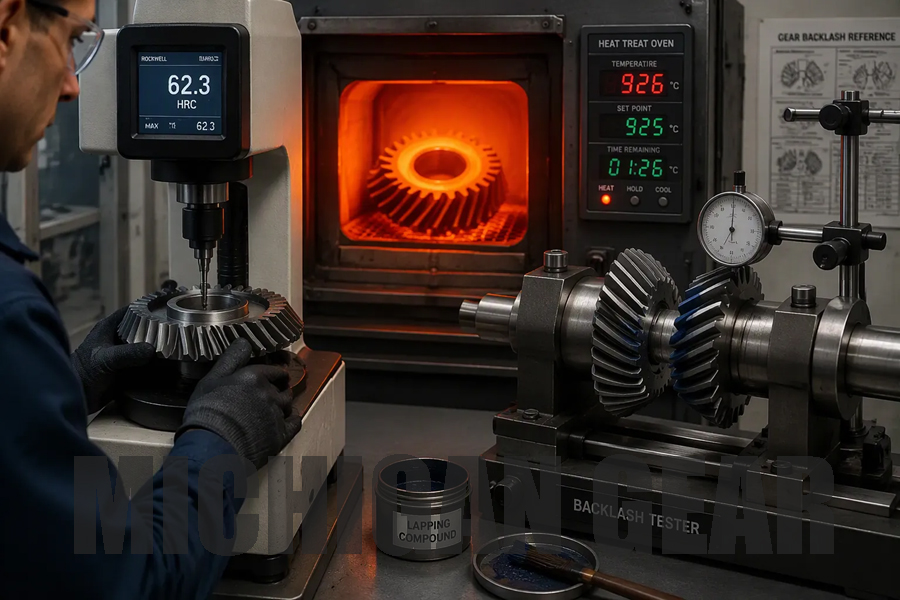
I ask this question to learn whether the manufacturer controls the process in-house or outsources it. In-house heat treatment gives tighter control over temperature, soak time, and cooling rates. Outsourcing adds a layer of risk because the supplier cannot monitor the furnace directly. I want to hear specific details about their method. Do they use case hardening, through hardening, or nitriding? Each method suits different load and wear conditions. A capable manufacturer matches the treatment to the application instead of applying one default process to every part.
I also ask how they control distortion during heating and quenching. Miter gears have complex tooth geometry. Uneven cooling warps the teeth and ruins the mesh. A serious manufacturer uses fixtures, controlled atmospheres, or press quenching to hold dimensions. They also verify hardness after treatment with documented test results. I request the hardness specification and the acceptable range before I approve any order. A supplier who cannot state their target hardness range has not thought this through.
Question 8: Can You Supply Matched Pairs?
Matched pairs matter more than most buyers realize. Two miter gears that mesh together must share the same tooth geometry, backlash, and contact pattern. A manufacturer who ships random gears from a batch creates mismatched sets. Those sets run loud, wear unevenly, and fail early. I always ask whether the supplier laps or tests pairs together before shipping.
A proper matched pair goes through a lapping process. The manufacturer runs the two gears together with abrasive compound to seat the tooth surfaces. This step reduces backlash and creates a smooth contact pattern across the tooth face. The result is quiet operation and even load distribution. I ask for the backlash measurement on the matched set, not just the individual gears. I also want to know how they mark and package the pair. Clear labeling prevents mix-ups on the assembly floor.
A supplier who offers matched pairs as a standard option shows they understand real-world performance. A supplier who treats it as a special request tells me they ship parts, not solutions. I pay close attention to this answer because it separates a true miter gear specialist from a general job shop.
Experience, References, and Lead Times
A long track record does not guarantee perfection. It does show that a manufacturer survived real production pressure. I use tenure as one signal among many, never as the only one.
Question 9: How Long Have You Been in Business?
I ask this question to gauge stability. A shop that has cut gears for decades has weathered material shortages, equipment failures, and demanding customers. That history builds process knowledge you cannot rush. Newer shops can still deliver excellent work. I simply dig deeper into their equipment, staff, and past projects.
I also request client references. I want names of companies with similar applications, not a generic list. Then I call those references. I ask about on-time delivery, response to problems, and whether they would order again. A manufacturer who hesitates to share references tells me something important. A confident one connects me with customers who speak plainly.
Question 10: What Are Your Lead Times?
Lead time answers reveal capacity and honesty. I ask for the standard lead time and the lead time during peak season. A supplier who quotes the same number for both has not thought about their workload. I also ask how they handle rush orders and what triggers a delay.
I confirm delivery schedules in writing before I commit. I want to know their monthly capacity for the miter gear sizes I need. A shop that overbooks will push my order back without warning. I ask about their backlog and their on-time delivery rate. Vague answers here signal trouble. Clear answers, backed by data, tell me they plan production instead of reacting to it.
Red Flags to Watch For
I have learned to trust my instincts when a supplier’s answers feel slippery. Certain warning signs appear again and again in my supplier evaluations. These signals tell me to walk away before I waste time and money.
Vague Answers on Tolerances and Materials
I ask direct questions about tolerance ranges and material grades. A reliable manufacturer answers with specific numbers and named alloys. A risky one deflects with phrases like “industry standard” or “whatever works best.” That response tells me they either do not know their own processes or they hope I will not notice.
I also probe how they handle inspection documentation. A confident supplier describes their measurement tools and reporting format without hesitation. A supplier who avoids the topic or promises paperwork “later” raises immediate concern. Without well-documented requirements, suppliers may struggle to meet standards. That gap leads to inconsistencies, defects, and compliance risks. I treat vague answers as a sign that quality control is an afterthought.
No Documentation or References
I always ask for matched-set testing records and sample inspection reports. A manufacturer who hesitates to share these documents has something to hide. I also request client references from companies with similar applications. A supplier who cannot name a single satisfied customer tells me everything I need to know.
Request references from other clients and ask about their experiences with the supplier. This offers valuable insight into the supplier’s reliability and service quality.
I use several tools to verify a supplier’s track record before I commit:
●Reference checks confirm reliability through feedback from other customers or industry partners.
●Supplier self-assessments require detailed questionnaires on quality controls, compliance history, and past performance.
●Documented risk assessments evaluate financial stability, regulatory compliance, and past performance.
A manufacturer who welcomes this scrutiny earns my trust. One who resists it never gets my order. I apply the same standard to every miter gear supplier I evaluate.
Quick-Reference Checklist for Buyers
The 10 Questions at a Glance
I keep this table on hand during every supplier call. It condenses the full framework into one page I can scan in minutes.
| # | Question | What a Strong Answer Includes |
|---|---|---|
| 1 | Do you specialize in miter gears? | Miter gears named as a core product, not filler work |
| 2 | What industries do you serve? | Experience in your sector, plus ISO 9001, IATF 16949, or AGMA standards |
| 3 | What design software do you use? | Named CAD and gear-specific design tools |
| 4 | Can you reverse engineer existing gears? | A documented measuring and modeling process |
| 5 | What QC processes do you follow? | In-process checks, final inspection, traceability |
| 6 | Can you provide inspection reports? | Sample reports with measured values and material certs |
| 7 | How do you handle heat treatment? | In-house control, stated hardness range, distortion control |
| 8 | Can you supply matched pairs? | Lapping, backlash measurement, clear pair labeling |
| 9 | How long have you been in business? | Tenure plus client references you can actually call |
| 10 | What are your lead times? | Standard and peak-season numbers, confirmed in writing |
I score each answer on a simple three-point scale: strong, partial, or weak. A strong answer gives specifics. A partial answer covers the topic but stays general. A weak answer dodges the question or promises details later.
I weight the questions by risk. Questions 5, 6, 7, and 8 carry the most weight for me. Quality control, documentation, heat treatment, and matched-set capability decide whether the parts perform in the field. Questions 1 and 2 come next because specialization and industry fit shape everything downstream. I treat the remaining questions as tiebreakers between otherwise equal suppliers.
Any weak answer on a high-weight question ends the evaluation. Two or more weak answers anywhere tell me to look elsewhere. I write the scores down during the call. Notes taken in the moment beat memory every time.
I ask these questions before every order because they protect quality, budget, and schedule. A reliable miter gear manufacturer welcomes technical scrutiny. They share inspection reports, hardness data, and matched-set records without hesitation. That openness tells me more than any sales pitch.
I keep the 10-question checklist beside me during every supplier call. It turns a vague conversation into a structured evaluation. I score each answer and walk away when the weak ones pile up. You can do the same. Request a quote, a sample, or a consultation with your top candidate. Then let their answers decide.
FAQ
How do I verify a manufacturer’s quality claims before ordering?
I request sample inspection reports and material certifications first. I look for measured values, the inspection method, and acceptance criteria. I also ask for matched-set testing records. A supplier who shares full documentation freely earns my trust. One who delays or deflects does not.
What matters most in a matched pair of gears?
Lapping seats the tooth surfaces together and creates a smooth contact pattern. I ask for the backlash measurement on the set, not the individual gears. Clear labeling also prevents mix-ups on the assembly floor. A matched pair runs quieter and wears more evenly.
Should I worry if a supplier outsources heat treatment?
Yes, I treat it as a risk. Outsourcing adds a layer between the manufacturer and the furnace. I prefer in-house control over temperature, soak time, and cooling rates. If they outsource, I ask how they verify hardness and control distortion afterward.
How do I check a supplier’s reputation?
I request references from companies with similar applications, then call them. I ask about on-time delivery, problem response, and whether they would order again. A manufacturer who hesitates to share references tells me something important. A confident one connects me directly.
What lead time details should I confirm in writing?
I ask for standard lead time and peak-season lead time separately. A supplier who quotes the same number for both has not thought about workload. I also confirm monthly capacity for my gear sizes and their on-time delivery rate. Vague answers here signal trouble.
Post time: Sep-28-2026