


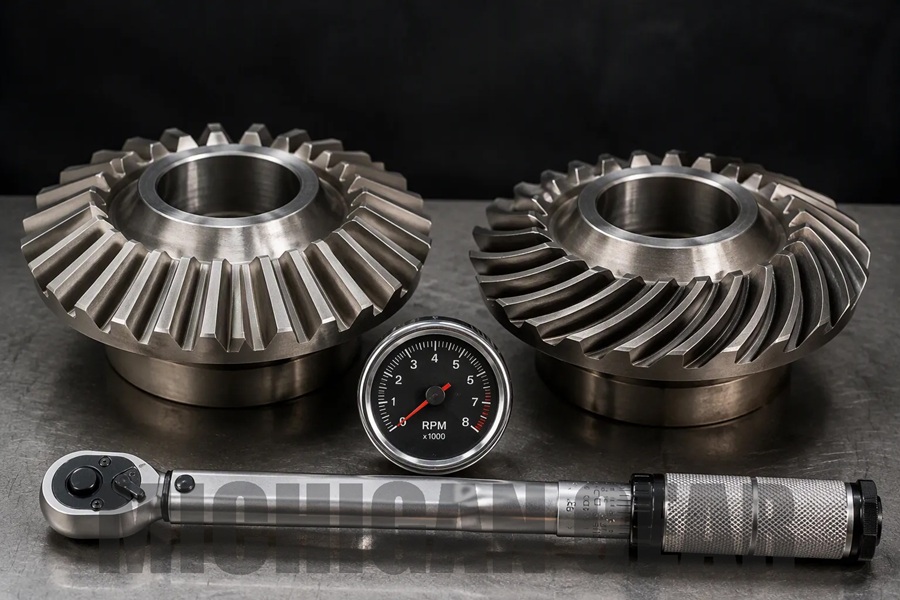
You need a miter gear that handles both high speed and high torque. That combination creates a real dilemma for any designer. Spiral miter gears generally win here. Their curved teeth engage smoothly and carry more load. Straight designs can still work when your speed and torque demands stay low and your budget is tight.
The right choice depends on your specific operating conditions. Speed, torque, noise, and cost all play a role. I will help you sort through these factors. You can then select the gear that fits your application best. A careful review of your needs will guide you to the correct option.
Key Takeaways
●Spiral miter gears handle high speed and high torque better than straight gears.
●Spiral gears run quieter and last longer, but they cost more upfront.
●Straight miter gears work well for low speed and low torque jobs on a budget.
●Choose spiral gears for demanding tasks like aerospace or marine applications.
●Always align shafts and set backlash correctly to make any miter gear last.
What miter gears are and how they work
Defining miter gears vs. bevel gears
A miter gear is a special case of bevel gear. It connects shafts at right angles. A general bevel gear can connect shafts at almost any angle, subject to practical limits. Miter gears stay fixed at 90 degrees.
The key difference lies in the gear ratio. Miter gears use equal tooth counts. That means a 1:1 ratio. They change only the direction of rotation. They do not change speed or torque. A bevel gear can use various ratios, such as 3:1, for speed reduction or multiplication.
| Feature | Miter Gears | Bevel Gears |
|---|---|---|
| Gear Ratio | 1:1 (equal tooth counts, pure direction change) | Various ratios (e.g., 3:1) for speed reduction or multiplication |
| Application | Applications needing only direction change (e.g., hand drills) | Applications requiring direction change plus ratio change (e.g., automotive differentials) |
According to PIC Design, miter and bevel gears come with ratios from 1:1 to 1:4. The standard 1:1 ratio defines a miter gear set. For a standard 90-degree drive, a 1:1 set splits the angle 45/45 degrees. Those equal-tooth-count bevel gears are called miters. A 3:1 reduction gives roughly 18/72 degree cone angles.
Straight and spiral tooth designs explained
Tooth geometry separates straight from spiral miter gears. Straight teeth run parallel to the cone axis. Spiral teeth curve along the face. This curve changes how the teeth engage.
Mounting demands more care than spur gears. A spur gear mounts on parallel shafts. A miter gear set needs precise alignment on intersecting shafts. Incorrect alignment causes noise, wear, and early failure. I always check shaft angle and backlash before running a new set.
Straight vs spiral miter gear performance
Speed capability and torque capacity
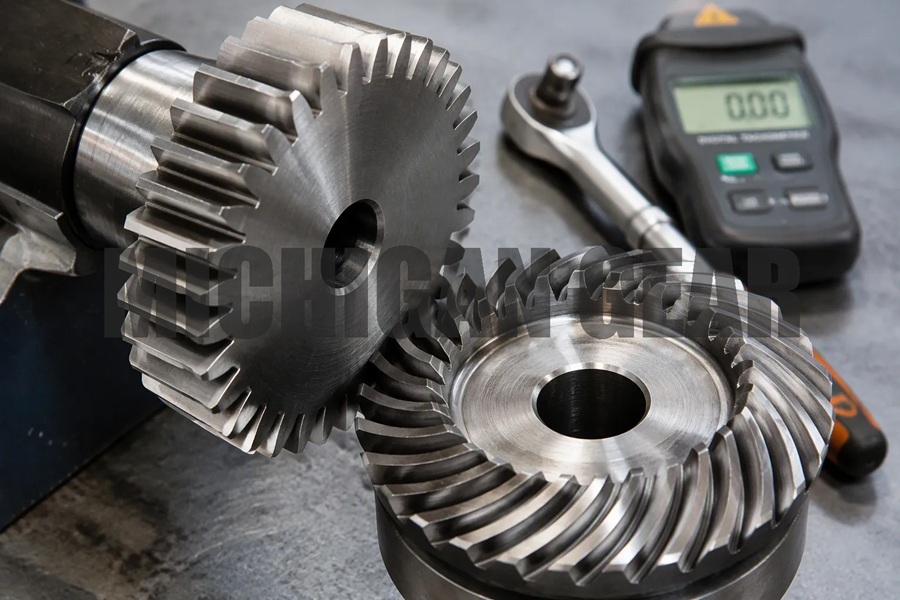
Speed and torque tell the real story here. I look at these two numbers first when I size any right-angle drive. A straight miter gear handles moderate speed well. Its teeth meet all at once along the full face width. That sudden contact limits how fast you can run it. Push the speed higher and vibration grows quickly.
A spiral miter gear spreads contact across several teeth at the same time. The load moves smoothly from one tooth to the next. This gradual engagement lets the gear run faster without shaking itself apart. For the same pitch, module, and material, a spiral miter gear typically carries 30 percent more torque than an equivalent straight miter gear. That margin matters when your application demands both speed and load.
Torque capacity follows the same pattern. Straight teeth concentrate stress at the tooth root during each impact. Spiral teeth share that stress over a longer contact path. The result is a stronger mesh under the same envelope size. I can often downsize a spiral set and still meet the same torque target.
One detail surprises many designers. A spiral miter gear with a helix angle less than 10 degrees receives forces from the same direction as a straight miter gear. This low-angle design offers excellent precision. It also keeps bearing loads predictable. You get the smoothness of spiral teeth without adding complex thrust bearings.
Efficiency, noise, and cost comparison
Spiral designs have curved teeth. That curve produces smoother engagement, less noise, and higher efficiency. The sliding action between teeth stays gradual. Energy loss drops. Sound pressure drops too. I have measured noticeable noise reduction on spiral sets in the same housing.
| Factor | Straight Miter Gear | Spiral Miter Gear |
|---|---|---|
| Torque capacity | Baseline | 30% higher |
| Noise level | Higher | Lower |
| Efficiency | Good | Higher |
| Cost | Lower | Higher |
| Speed ceiling | Moderate | High |
Cost is the trade-off. Straight miter gears cost less to make. Cutting straight teeth takes fewer operations. Spiral teeth need special cutters and careful setup. That extra work shows up in the price.
I weigh this cost gap against the total system. A cheaper straight gear may need a larger frame, more bearings, and sound damping. Those extras erase the savings fast. For high speed and high torque together, the spiral miter gear usually wins on total cost of ownership.
When to choose a straight miter gear
Low-speed, low-torque applications
I recommend straight miter gears when your application runs at low speed and carries light loads. These conditions match many industrial machines that prioritize accuracy over power. I see straight gears in printing presses where register control demands precise positioning. Textile machinery and packaging lines also use them for the same reason. Speed stays low. Torque stays low. The straight tooth design handles these conditions without issue.
Material choice often determines how well a straight gear performs in low-torque situations. Engineering plastics like nylon, POM, and PEEK work well for robotics and medical devices. These materials weigh less. They resist corrosion and do not conduct electricity. Their lower tensile strength limits them to low-torque scenarios, but that fits perfectly here. Bronze and brass also appear in instrumentation and small machinery. They run quietly, create low friction, and offer self-lubricating properties. The lower load capacity compared to steel does not matter when torque stays low.
Straight miter gears generate less axial thrust during operation. This characteristic reduces your need for thrust bearings in the gear assembly. The simpler bearing arrangement saves space and cost. I also find straight gears useful in precision instruments like survey equipment, gun sights, and radar elevation drives. These applications operate at low speeds but demand high accuracy and repeatability. The straightforward engagement of straight teeth delivers consistent positioning.
Budget-friendly projects
Cost often drives the decision when your project has limited funding. Straight miter gears cost less than spiral gears. Their simpler design requires fewer manufacturing steps. The tooling costs less. The setup takes less time. These savings pass directly to you.
I also consider the reduced need for specialized bearings. Lower axial thrust means standard bearings often suffice. You avoid the expense of heavy-duty thrust bearings that spiral designs sometimes require. The compact size of straight miter gears helps in tight spaces too. They provide efficient power transmission with minimal energy loss while fitting into small envelopes.
You can combine straight miter gears with other gear types like spur gears, helical gears, or worm gears. This flexibility lets you achieve more complex gear ratios and mechanical advantages without buying a custom gearbox. For a cost-sensitive project running at low speed and low torque, straight miter gears deliver reliable performance.
When to choose a spiral miter gear
High-speed and high-torque demands
I reach for a spiral miter gear when my application pushes both speed and load at the same time. Straight miter gears work fine below about 1,000 RPM. Above that threshold, the abrupt tooth engagement creates impact forces that grow with speed. A spiral miter gear handles this differently. Its curved teeth engage progressively, so contact rolls from one end of each tooth to the other. This gradual mesh lets the gear run steadily at speeds higher than 3,000 RPM, with a maximum efficient speed of 8,000+ RPM.
Torque capacity follows the same pattern. Spiral bevel gears carry roughly 30 percent more torque capacity than straight bevel gears in the same envelope. The curved tooth spreads load over a larger area and for a longer duration. I see this matter most in demanding industries. Aerospace uses spiral miter gears in landing gear systems and flap actuators. Marine applications rely on them for steering mechanisms and winch drives. Mining equipment needs the shock load capacity and wear resistance that spiral teeth provide. One maintenance director put it plainly: these gears outperformed their previous supplier’s parts by a wide margin, and downtime dropped drastically.
Quiet operation and smooth engagement
Noise reduction alone justifies the switch for many of my projects. Spiral miter gears reduce noise by 6 to 10 decibels compared to straight teeth. That difference matters in enclosed spaces or near operators. The mechanism behind this quiet operation is simple. Straight teeth slam into contact across the full face width all at once. Spiral teeth initiate contact at one end and move along the tooth. The force ramps up smoothly instead of impacting suddenly.
This smooth engagement delivers a second benefit I value just as much. Enhanced operational smoothness makes bearings last 30 to 40 percent longer. The gradual load transfer reduces vibration and transmission error. I also appreciate the compact installation footprint. Spiral miter gears save space in robotic arm joints and machine tool headstocks. For any application demanding quiet operation and long service life, a spiral miter gear is my default recommendation.
Spiral miter gears beat straight miter gears on speed, torque, noise, and efficiency. They carry 30 percent more torque and cut noise by 6 to 10 decibels. That performance costs more upfront. I still treat spiral as my default choice for high speed and high torque. Straight miter gears suit undemanding, cost-sensitive projects.
Your own numbers should drive the final call. Check your speed, torque, noise limits, and budget. Then review the gear specifications or ask an engineer. One last point: proper mounting protects that investment. Correct shaft alignment and backlash keep any miter gear running smoothly for years.
FAQ
Can I swap a straight miter gear for a spiral one in the same housing?
Not always. Spiral teeth create different thrust loads. A low helix angle under 10 degrees keeps forces in the same direction as a straight gear. Higher angles need thrust bearings. I check the bearing setup before any swap.
Do spiral miter gears cost much more than straight ones?
Yes, they cost more upfront. Spiral teeth need special cutters and careful setup. That extra work raises the price. I still weigh total system cost. A straight gear may need a bigger frame and sound damping, which erases the savings.
What speed limit should push me toward a spiral design?
I switch to spiral above roughly 1,000 RPM. Straight teeth engage all at once, so impact forces grow with speed. Spiral teeth roll into contact gradually. That lets them run past 3,000 RPM, with a maximum efficient speed above 8,000 RPM.
Will a spiral miter gear really run quieter?
Yes. Spiral miter gears cut noise by 6 to 10 decibels compared to straight teeth. The curved teeth start contact at one end and move along the tooth. Force ramps up smoothly instead of slamming across the full face width.
Does a miter gear change my speed or torque?
No. A miter gear uses equal tooth counts, so the ratio stays 1:1. It only changes the direction of rotation by 90 degrees. If you need a speed reduction or torque increase, choose a bevel gear set with a different ratio instead.
Post time: Sep-23-2026